


(Listen to the radio version here.)

On September 14, when a female Pileated Woodpecker flew to my bird feeder, I noticed that she was wearing an aluminum leg band on her right leg. I instantly grabbed my camera, took a couple of photos from inside through the window glass, and then ran out the back door hoping for better. The feeder she was at is in our side yard outside the dining room window. She couldn’t see me well as I ducked behind the corner of the house, but from there the feeder blocked my view of her leg band, so I crept along the house to the box elder that is right next to the house. She didn’t seem bothered at all, but the band was still mostly hidden, so I moved to the other side of the tree, where I had a perfectly clear view, just 12 or 13 feet from her with no obstructions at all.

The male banded Pileated Woodpecker (BB for “Banded Boy”) whom I kept track of for more than four years was extraordinarily tolerant of me but usually flew away when I was in that exact spot, which may have been a little too close for comfort. This female looked directly at me a couple of times but stayed put, feeding calmly as I took a bunch of photos to ensure that I had some clear, focused ones of the band from this side. When I was satisfied, I retraced my steps to the back door and rushed through the house and out the front door. Now I headed to the fence on the opposite side of the feeder, about 20 feet from her, capturing her leg band from that vantage point. In my head, I was already calling her BG (for “Banded Girl”).

Every songbird band issued by the USGS Bird Banding Lab has a seam where it was crimped closed,1 marking the beginning and the end of the band number, and a hyphen between the first three or four digits and the last five, so photos showing either the crimp or the hyphen help work out where the numbers fall in the string. Each well-focused photo of mine showed two or three digits and sometimes the crimp or the hyphen. And this wondrously cooperative female returned a few times in the next two days, each time allowing me to get photos of both sides of the band, so it didn’t take very many sets of photos to work out the 8-digit string.

I expected the band to have 9 digits, as have all bands issued by the Bird Banding Lab in the past 15 or 20 years, but this band’s inscription with the phone number and mailing address of the Lab meant it had been issued between 1995 and 2010 at the latest, and it bore only 8 digits: 844-65412. On Thursday, September 17, I went to the Bird Banding Lab’s “Report Band” website and entered those numbers; it automatically added a 0 at the beginning and sent an auto-reply that no bander had submitted a report for that number yet. When the bander’s report was received, they’d send confirmation and my certificate for reporting a band.
I haven’t yet received that confirmation from them, but got something much better! Hawk Ridge Bird Observatory’s annual Hawk Ridge Weekend started Friday, and I got to spend a bit of time with Margie Menzies, the Hawk Ridge Education Director who does a lot of songbird banding at the Ridge. Margie said the Hawk Ridge banding team2 had banded a Pileated Woodpecker this fall, and she’d check her records to see if the numbers matched my bird.
This being peak migration at Hawk Ridge, Margie is busy every day with all kinds of banding and program activities, so she hasn’t had a chance to submit this season’s data to the Bird Banding Lab yet. I figured it would take her at least a few days to get back to me, but nope—the very next day she sent an email confirming that the bird bearing this band number was banded at Hawk Ridge as a hatch-year female on August 31.
I would have been shocked if I’d found a warbler Margie had banded this year with such an old band. She bands a bazillion warblers and other tiny birds that wear very small bands. Besides Pileated Woodpeckers, most of the birds requiring a band of size 4 or 3A are Sharp-shinned Hawks, American Kestrels, Merlins, Northern Saw-whet Owls, and similar-sized birds, and those birds of prey generally get a lock-on, not a crimped band. The Hawk Ridge songbird-banding team has banded all of those, but they’re much more focused on songbirds and smaller woodpeckers. No wonder there’s still a supply of Pileated Woodpecker-sized bands. The mystery was solved!
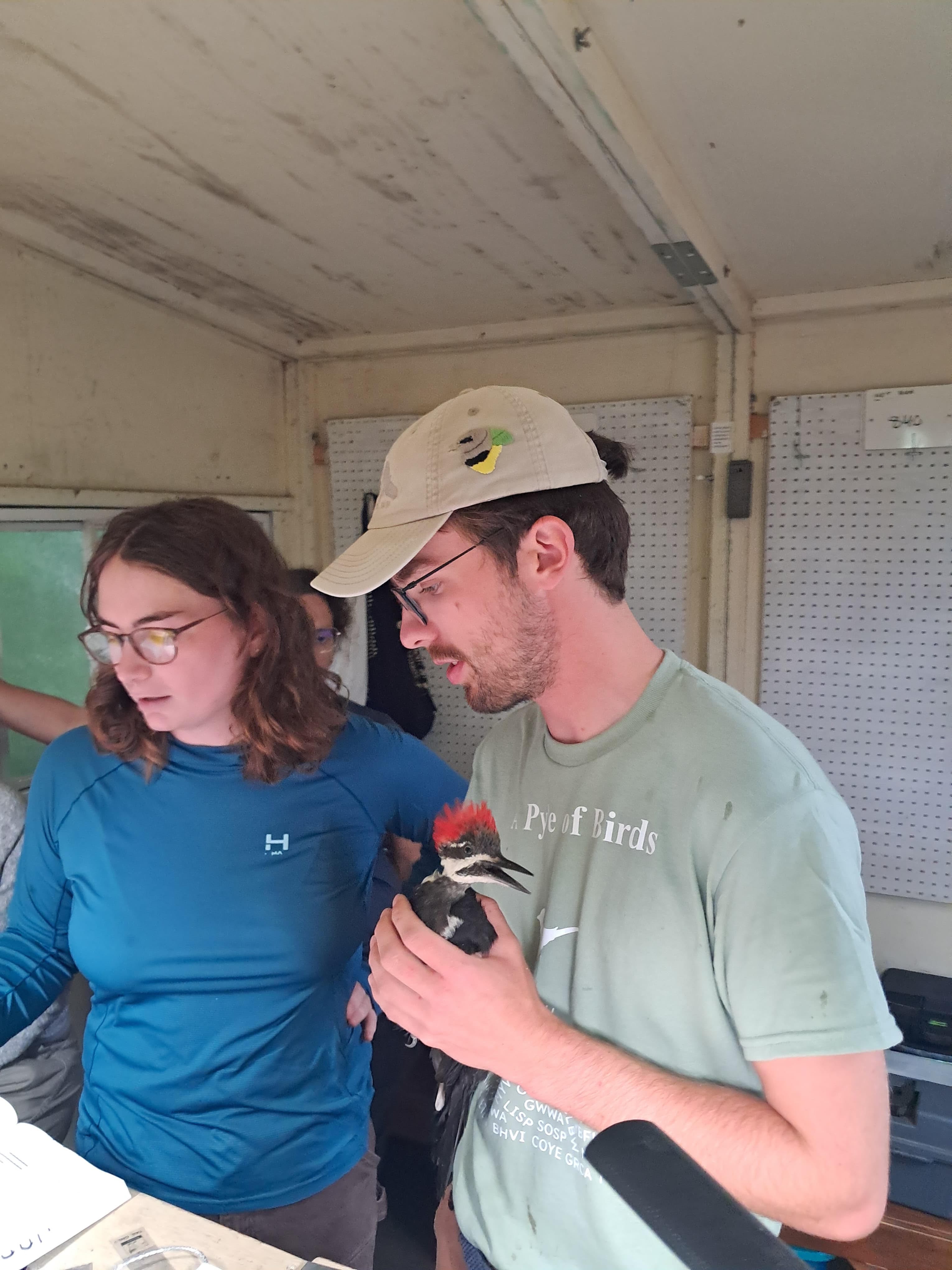
Banding so very many birds each season along with so many other duties, details get a little blurry, so Margie sent out a note to the banding team asking if anyone had more details about this individual. Sure enough, it turns out Peter Mundale was the bander who put the band on BG, and the team took photos!
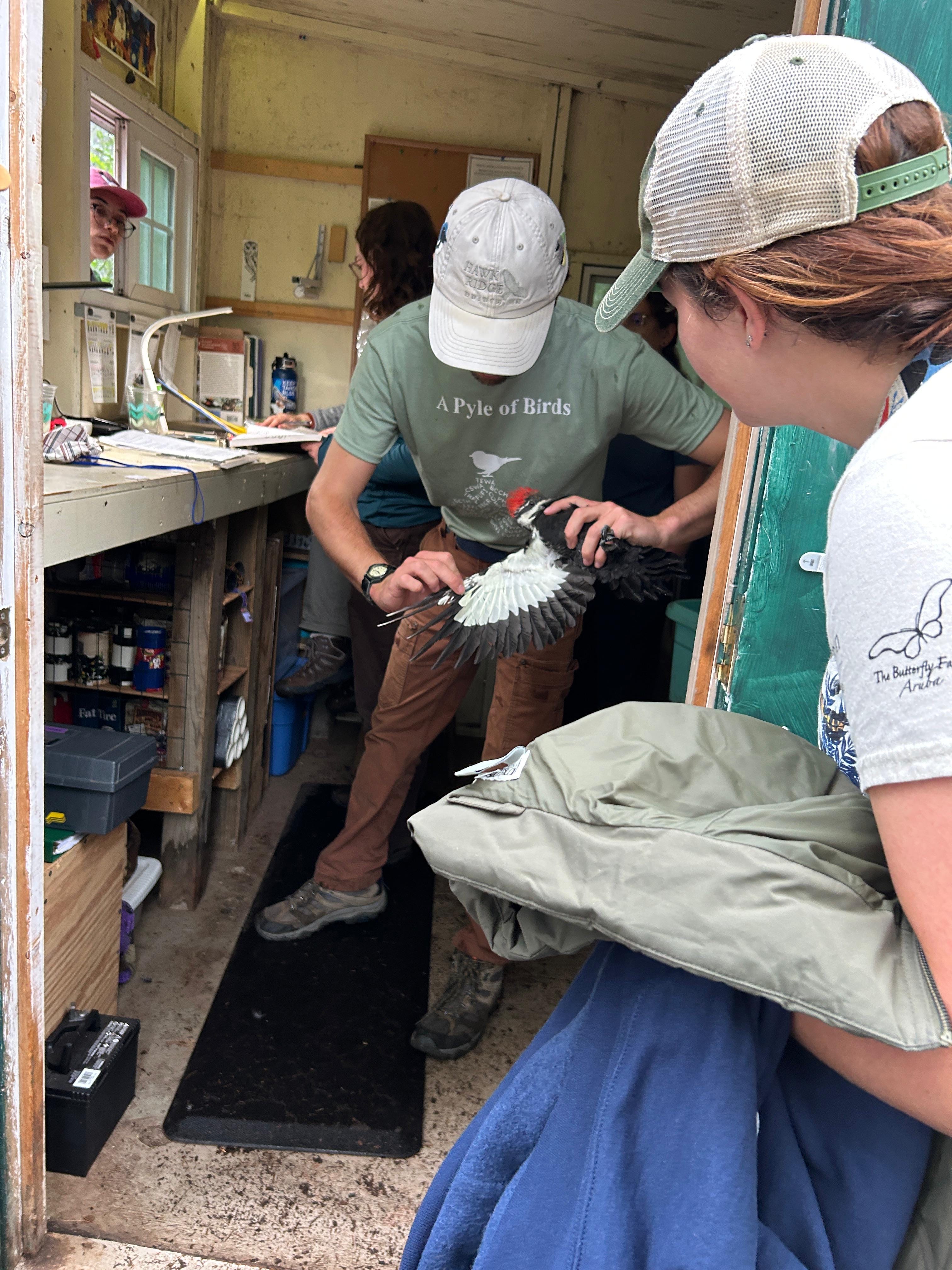
It’s easy for just about anyone to determine the sex of a Pileated Woodpecker: males and females both have that distinctive red crest, but all males have a red forehead and red malar stripe (“mustache”); those features are never red on females.
Figuring out a Pileated Woodpecker’s age is a different story. From May through September, juvenile birds tend to have duller plumage and irises, but these differences are subtle. Unless a fledgling is being fed by an adult, or an adult looks very bedraggled after raising young, I simply cannot tell whether a Pileated I see is a hatch year bird or an adult.
Bird banders can confirm age by looking at “P10”—the outermost primary wing feather. In juvenile birds, it extends more than 24 mm beyond the primary covert feathers, while it extends less than 21 mm in older birds; it’s also more rounded at the tip in young birds than in adults. This kind of information for every species is included in the “bird bander’s bible,” Peter Pyle’s Identification Guide to North American Birds. That’s how the banders could confirm that this Pileated had hatched in 2026.
From the first time I noticed her, I couldn’t help but wonder if BG might be the same bird who visited my yard as a fledgling with her father a few times this summer.

He allowed me to get very close to his daughter.

I suspect (though there’s no way to confirm) that the father is the male who displaced BB in my yard this past winter, and I also suspect that he’s one of the young birds BB himself brought here in 2023 or 2025; BB didn’t get distressed when I photographed his babies, so his offspring didn’t see me as a threat.

Of course, because neither the father nor daughter was banded when I was watching them this summer, I can’t be certain of any of this, but it does explain BG’s extraordinary tameness. Whether or not she is that fledgling, I’m sure glad that she’s a young bird. If she sticks around, I may be able to observe her for years to come.

Well, bands used on many birds of prey and parrots are “lock-on bands,” designed without the crimp to prevent birds from prying the band open, risking hurting the bird as well as the band.
Federally licensed bird banders have been placing bird bands on migrating birds passing through Duluth at the Hawk Ridge Bird Observatory (originally Hawk Ridge Nature Reserve) since 1972. Apprentice banders undergo a lot of training before they can earn their own banding permit.
She’s so beautiful!