


Listen to the radio version of Part 1 here and Part 2 here.

Part 1: Ectoparasites
Setting out nest boxes seems like a low-maintenance kind of thing—you set out a high-quality birdhouse in a good location, and birds nest in it—end of story. But after the babies leave the nest, it’s important to clean out the nest box as soon as possible.
Parent birds keep up with nest sanitation as best they can. Baby bird poop is produced in “fecal sacs” with a sturdy membrane, and nestlings have the useful habit of pooping right after swallowing food, while the parent is usually right there to deal with it. 1

But babies being what they are, sometimes they poop when the parent isn’t present, or two babies get fed at the same time and the parent takes one sac, not noticing the other, and little by little, poop accumulates. That’s seldom a significant problem. By far, the more important issue as far as nest sanitation goes is the infestation of parasites, something parent birds have no control over.
Mites, which multiply quickly in old nest material, feed on both nestlings and brooding adults. Lice can transfer from parents to baby birds. Bird fleas, which feed on blood, complete their life cycle in nest lining. Black flies feed on incubating parents as well as nestlings, but are more a problem for birds whose nests are in the open, not in cavities.

Perhaps the worst scourges for cavity nesters are blowflies. They lay their eggs in nest material, and after hatching, the gray maggots use mouth hooks to pierce the skin of nestling birds to feed on their blood.
Mites, lice, fleas, black flies, and blowflies are all ectoparasites, feeding on their hosts externally (though some may work their way into ear or nostril openings). Heavy infestations can cause anemia, stunted growth, or tissue damage inside the nostrils causing a deformity called “shovel-beak.” Many nestlings survive, but fledging can be delayed, reducing the number of offspring the parents produce that season. After a severe winter, ectoparasites aren’t usually too big of a problem for the first nests, but when birds reuse a nest box or cavity that season, the parasites will be present from the start.

How can we protect nesting birds from these scourges? When I first learned about tick- and flea- preventive medicines, which are taken up in the skin and fur of cats and dogs, I thought that setting out a treated pet’s fur for birds might kill the parasites without hurting the birds, but studies have shown that the treated fur directly harms baby birds. I wrote about the issue in 2025, when scientists in the UK examined the fur lining in 103 nests of Eurasian Blue Tits and Great Tits collected in 2020. The species were chosen because, like our own chickadees and titmice, they virtually always line their nests with fur.
The scientists found that in every single nest, the fur was contaminated with at least 2 pesticides—in some, as many as 11—each one in common veterinary use to protect livestock and pets. But are these pesticides actually dangerous for birds? The researchers discovered that the more of these pesticides present in the fur incorporated into a nest, the fewer eggs produced and the higher the chick mortality. So when it comes to setting out fur from treated pets for your local nesting birds, please, just say no.
One reader took issue and I responded to her here.
I was a licensed wildlife rehabber for over ten years, but no one ever brought me baby birds that had been injured by ectoparasites. My more experienced friend, Koni Sundquist, dealt with heartbreaking cases of baby bluebirds and swallows that were suffering badly from blowflies. Koni, like a great many other knowledgeable people (including me until recently), called blowflies “botflies.”
Part 2: Internal parasites
Entomologists, like virtually all zoologists except ornithologists, make little effort to standardize the common English names for their subjects, and many people use the same common names in reference to more than one species or group. But “true” botflies are internal parasites. (The word bot has been in use in English since the 15th century in reference to the botfly maggots infesting horses.)
Botflies found in Canada and most of the United States belong to the family Oestridae, and their hosts are almost exclusively mammals. The botflies that infest birds belong to the family Muscidae and the genus Philornis; they are found mostly in Central and South America, though two species can be found in the southern states. Ridgway’s Hawk, an endangered raptor found only on the island of of Hispaniola, was suffering huge losses of nestlings due to botflies; conservation biologists from the Peregrine Fund, with grants from the Morris Animal Foundation, found that spraying the nestlings with an insecticide used on dogs and cats seemed to be helping. A botfly species that was introduced in the Galápagos Islands has become a scourge for endemic birds there. Again, bird botflies aren’t an issue in the Upper Midwest.
This summer, I had an extraordinary experience with a botfly of the species that infests eastern gray squirrels, fox squirrels, and eastern chipmunks (and much more rarely flying squirrels and American red squirrels); the species is commonly called the squirrel botfly. Its scientific name is Cuterebra emasculator, based on the misconception that it feeds on the testes of squirrels—in fact, the larva doesn’t start feeding when it enters a rodent until it finds a place just beneath the skin, where it settles down to feed on lymph fluid and possibly some cellular debris and leukocytes, not muscle or organ tissue.
Adult squirrel botflies look rather like dully colored bumblebees.
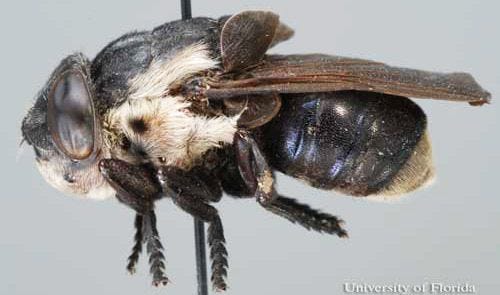
They emerge in early summer and search for a mate. Females lay as many as 1,000 eggs, which look like grains of rice, on twigs, branches, and vegetation where a host might come by.
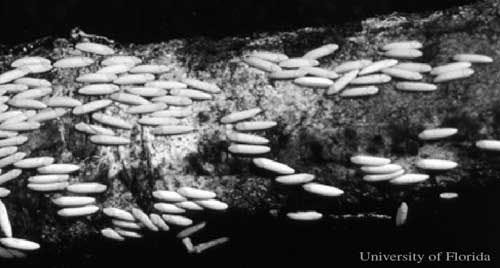
The larva develops within the egg into the first instar and then waits to emerge through the operculum (sort of a trap door) at one end of the chorion (what we call the eggshell in insects) until it senses heat or carbon dioxide from a nearby host. Then it pops out and sways back and forth on the substrate until it contacts and works its way onto the host animal; it then moves around searching for an opening—the mouth, nostrils, anus, or an open wound. Once inside, it moves around within the host’s body for up to a week until it finds a spot under the host’s pelt to settle in. Then it molts into the second instar and creates a visible hole to the outside, called a “warble pore,” that lets air in for breathing and allows it to eliminate excrement.
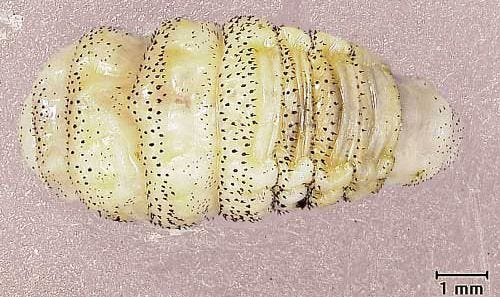
The anterior end of the larva is inside the host, the posterior end at the pore. The host’s tissue surrounding the larva forms a pocket, or “warble,” that encapsulates the larva and feels rather hard.
After a week or so in the warble, the larva molts into its third, final instar.
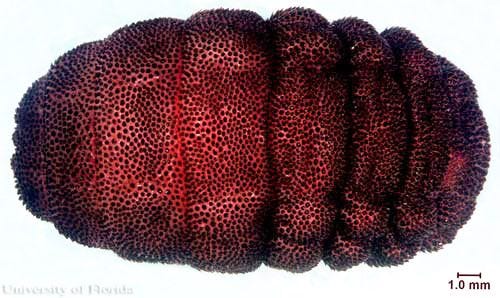
This is quite pale to begin with, like the first and second instar stages, but is covered with cuticular platelets that stiffen and darken, eventually becoming dark brown.
It takes about four weeks from hatching until the larva is mature; it backs out through the warble pore, drops to the ground, and burrows into the soil to pupate. The dark brown pupa remains in the soil through autumn, winter, and spring, and emerges as an adult the following summer to start the whole process again.
As with most obligate parasites who spend an important part of their life cycle in a host and emerge while the host is still living, Cuterebra emasculator seldom does permanent damage to the squirrel or chipmunk as long as it was an active adult or juvenile. Infant squirrels still nursing in the nest are another story. Sometimes a first instar bot that hasn’t worked its way into an opening on the mother moves to one of her babies. Many squirrel babies in the first litter of the year have left the nest by the time botfly eggs hatch, so aren’t affected until they’re big enough to survive. When I was a rehabber, I once raised a baby gray squirrel from a second nesting, in mid-summer. That poor little thing had a botfly inside its head and didn’t make it.
Because adult Cuterebra emasculator look like bumblebees, some flycatching birds avoid them, but they are nutritious and not the least bit dangerous. Some birds eat ticks and botfly larvae on large mammals—examples are the Canada Jay of North America…

…Giant Cowbird,

Yellow-headed Caracara,

and Smooth-billed Ani of South America...

… jackdaws in Europe, Asia, and northern Africa;
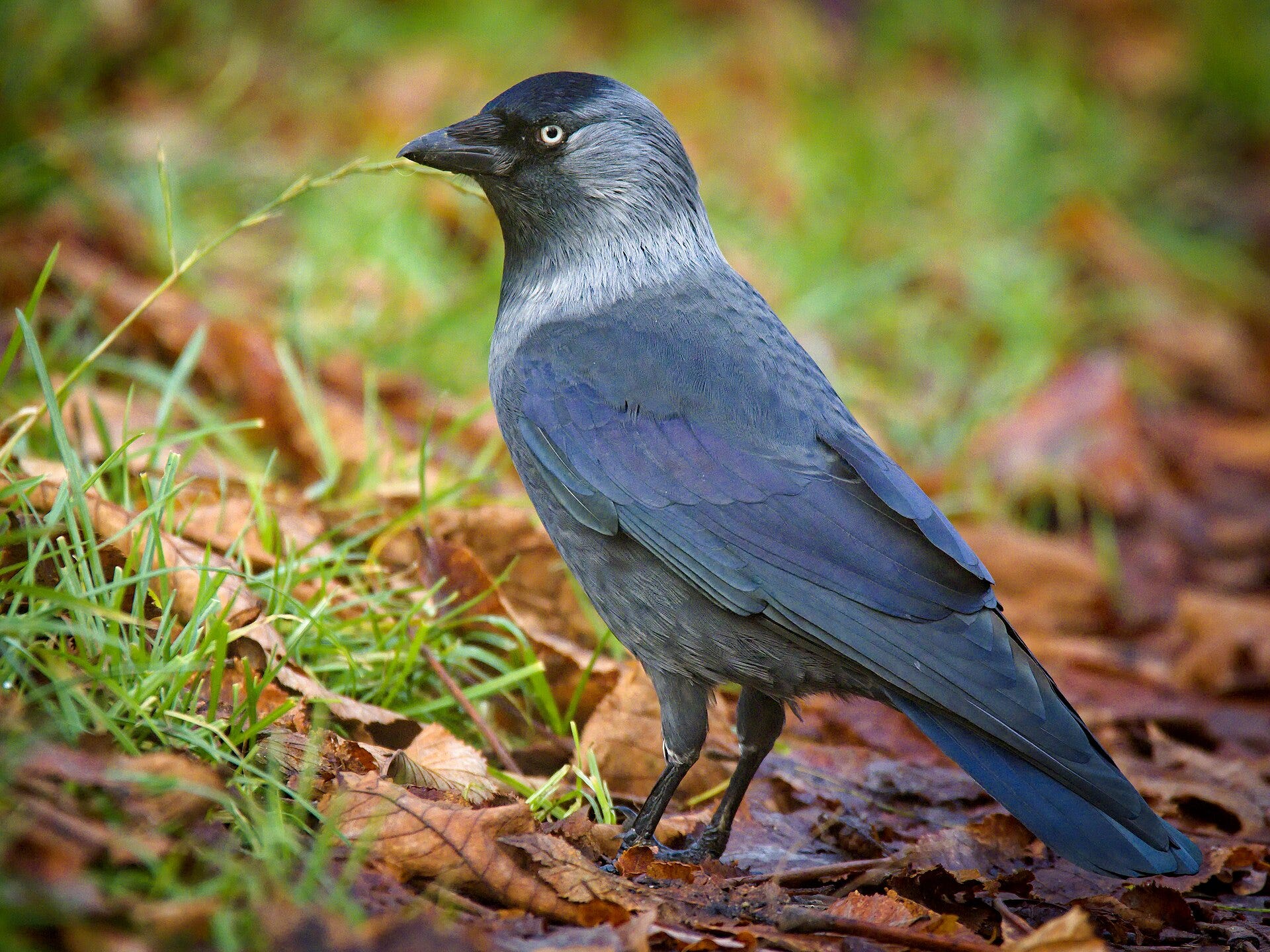
and oxpeckers in Africa.


Except for that long-ago baby squirrel, I’ve never noticed any other squirrels or chipmunks infested with a botfly until August. Several eastern chipmunks live in my little corner of Peabody Street, including two individuals who I know personally.

The first is a female who I first noticed in the summer of 2024, which I think was the year she was born. My son Joe was in town, and he’s the one who first started feeding her peanuts out of the hand, but she apparently generalized his friendliness to just about everyone she encountered, at least in the short-term. That summer, she was so trusting that she even let me pull up her back end to confirm that she was a female. She came here for food, but her burrow seemed to be two doors down—that’s always where she headed after loading up on peanuts. I named her Dizzy because when her cheeks were stuffed, she reminded me of Dizzy Gillespie.

On August 25, 2024, I discovered that either an accident or a predator had ripped off half of her tail. A thin string of vertebrae was still there.

By August 28, that had broken or fallen off.

She got through the winter of 2024-25 just fine, and come spring, she started coming around when she was pregnant and then while she was nursing. She’d become much more wary of people but still came reliably to me if I was anywhere in the back or front yard, and to other people if they were on the patio, especially if I was around, too.
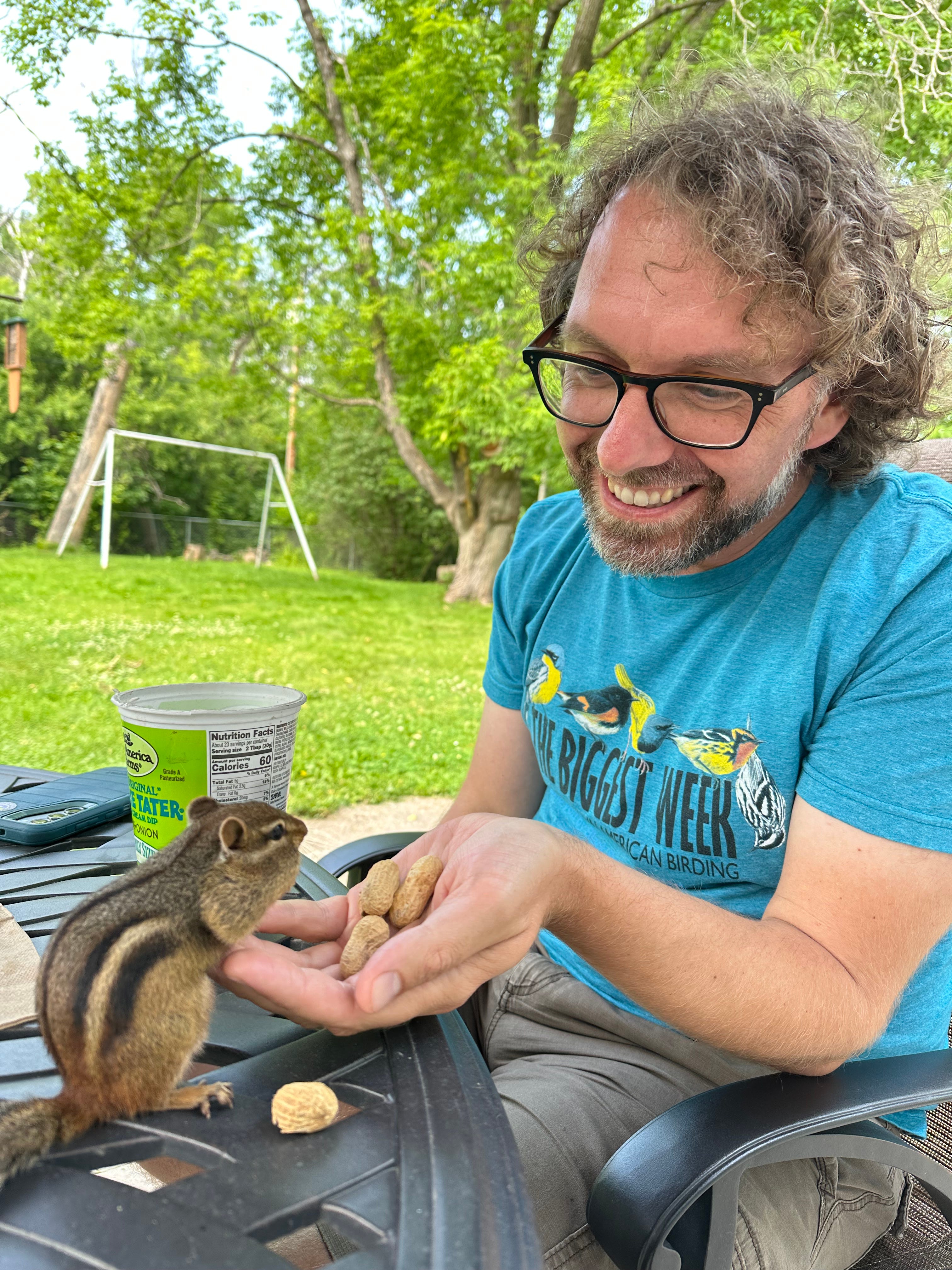
This year, Dizzy appeared once in early spring, but she must have found a closer food supply because it was weeks before she came back—I was afraid she’d died. Now, in the past couple of weeks she’s been by every day again—her friendliness and short tail make her easy to recognize. Meanwhile, this summer a new, young male started coming by. I call him Bizzy.
In July, one day I noticed that Bizzy had a lump about halfway down his left side. At first I was afraid that it was a tumor, but he seemed perfectly healthy and didn’t seem bothered by it—he even let me touch it to see how hard it felt. When I saw the warble pore, I realized this was a botfly. Unfortunately, I wasn’t taking as many backyard photos this year as I did last year, so I didn’t document it in the lump stage.
But on August 24, I was outside with my camera for several hours watching a monarch butterfly who had just emerged from the chrysalis. I’d set up a lawn chair by the milkweed, and all morning Dizzy and Bizzy came by for peanuts. Suddenly, at 9:57 am, I noticed that the lump on Bizzy looked weird, and realized that the larva was, right that very moment, in the middle of emerging. There I was, holding my camera, so of course I clicked away.


Bizzy didn’t stick around long—as soon as he had a big peanut in each cheek and one in his mouth, off he ran, and when he returned, the larva was gone, a gaping red wound with a hole where it had emerged.

Bizzy didn’t scratch or wash the injury or anything while I was watching—I don’t think the botfly caused him any discomfort from start to finish, and by the next day the wound wasn’t red at all. I took photos yesterday and you can hardly tell it was ever there.

No matter what the topic, my starting point for learning about anything is Wikipedia. They had an excellent entry for botflies and a short one about Cuterebra emasculator. My photos seemed useful in both, so I added them, along with life history information that I’d I unearthed that from the University of Florida’s Institute of Food and Agricultural Sciences website.
I love living in a world where a resource like Wikipedia is so freely available and where any of us can contribute—not for money or fame, but simply because it’s a Good Thing. That’s what civilization is all about.


In the days right after hatching, parent birds often eat the fecal sacs, which have little bacteria and a lot of undigested food. As bacteria builds in the nestlings’ guts, the parents fly off with the fecal sacs, disposing of them away from the nest.