

Canada Jay
What's in a name?

(Listen to the radio version here.)

In August 1979, my sister-in-law Jeanie and I took a road trip out West. We did a lot of camping in national parks, and WHOA! In the Big Horn Mountains, a LIFER alighted on my hand!! That was back when it was both legal and part of the culture of tent camping in national parks to share a bit of your food with the little critters who showed up at your campsite. I’d luckily set my Golden Guide on the picnic table, allowing me to page through it with one hand while figuring out that the bird on my other hand was my lifer Gray Jay! And the first sentence in the Golden Guide species account noted that it was “very tame.” Jeanie got several photos of that splendid lifer on my hand for me.


As I learned first hand literally, this bird is exceptionally approachable—indeed, we don’t even need to know one is there before it approaches us. When I’ve taken birders up the Sax-Zim Bog or some lovely spots north of Two Harbors, I’ve often brought peanuts along so they could have the same amazing pleasure I did, holding in their hand this brand-new lifer.
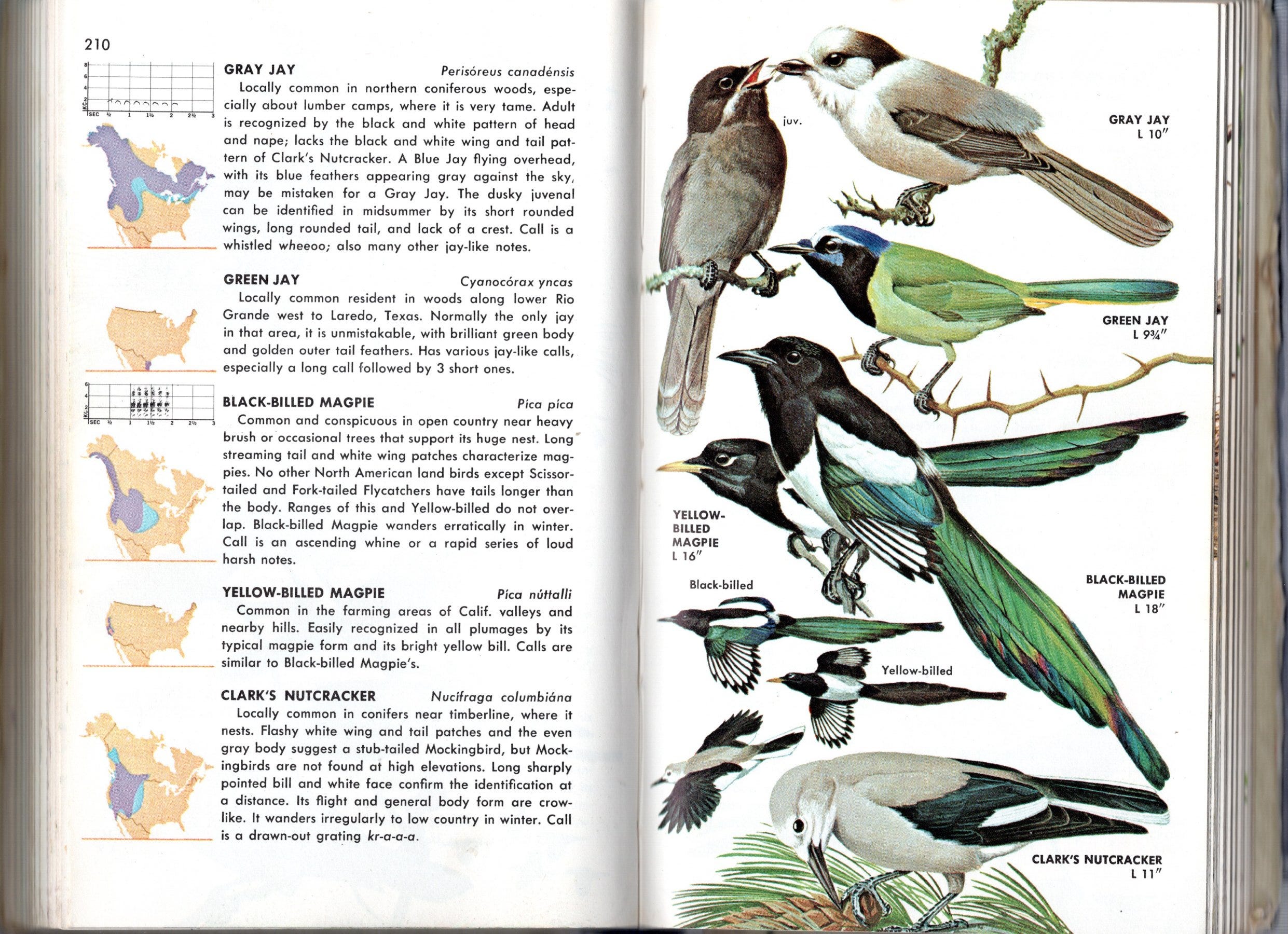
Fortunately, the Golden Guide showed both the soft white-and-gray adult plumage and the charcoal-gray juvenile plumage, so I never thought the new birds I was feeding in the Big Horn Mountains belonged to two different species. When I got home, I discovered that my Peterson guide showed only the adult plumage.
I’ve seen young Canada Jays in that plumage several times since, but never photographed them, so while I was planning this episode, I asked my friend Erik Bruhnke if I could borrow one of his for my blog post. He of course obliged.
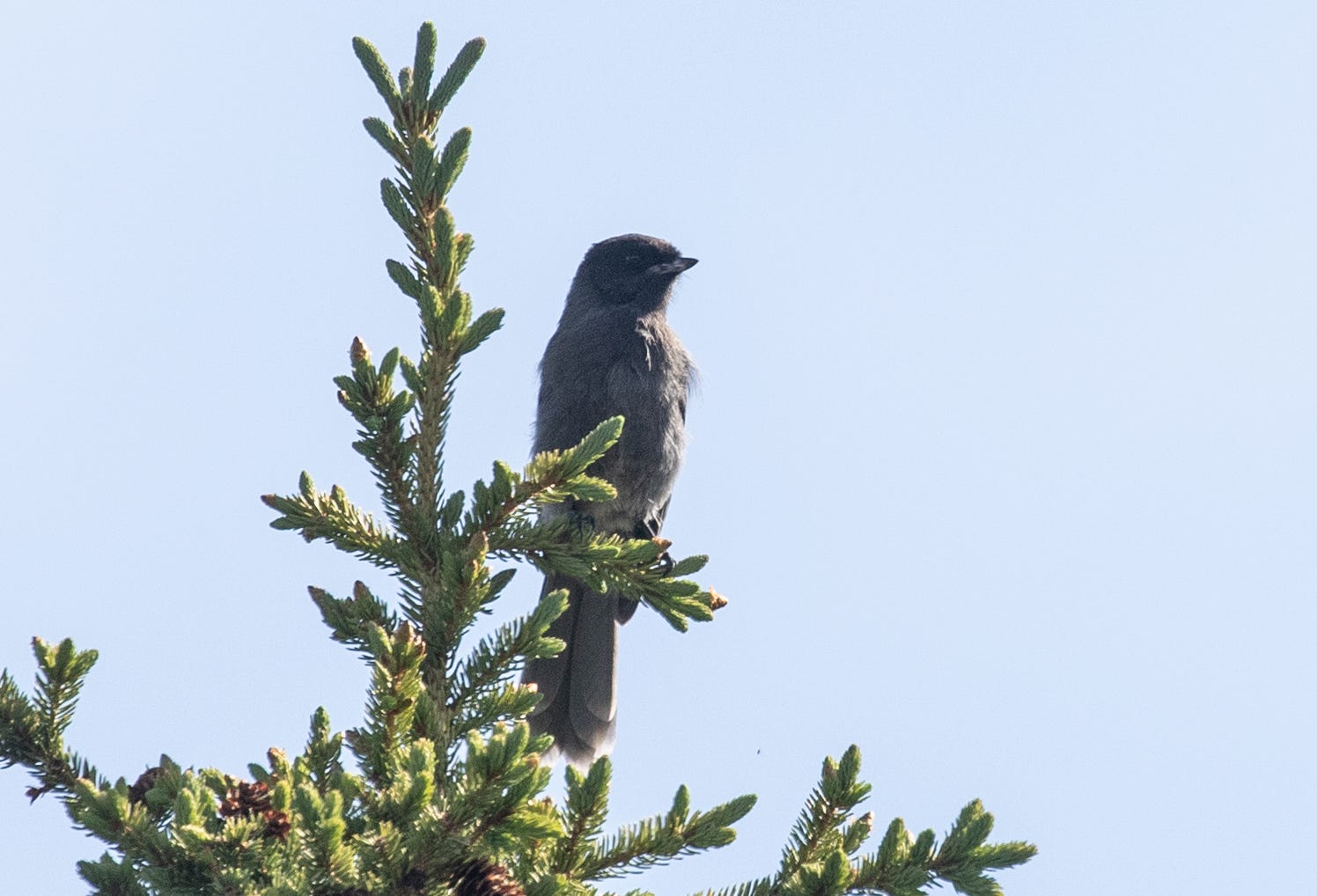
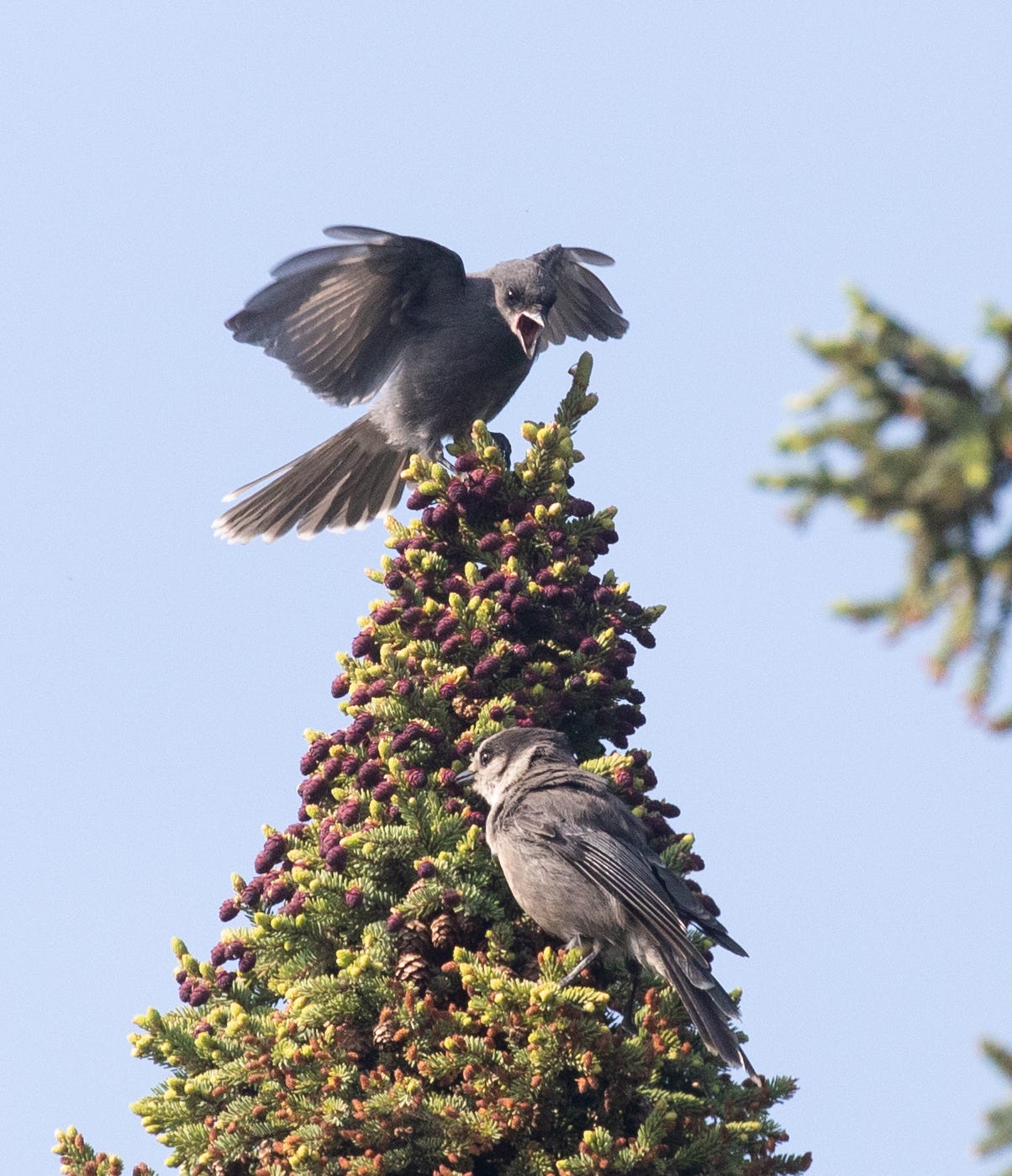
Then, this past weekend, when I was birding in the Bog with my friend Paula, two parents and a young bird came pretty close, even though we hadn’t brought along any peanuts. My photos aren’t the best, but I was delighted!


My old Peterson guide and my even older Audubon Land Bird Guide called the bird a Canada Jay—the name such early ornithologists as Swainson and Audubon called it in the 1830s and 40s, and what the American Ornithologists’ Union called it in the first edition of their Checklist in 1886.
I thought the name change to Gray Jay in 1957 was to make this species’ name consistent with the other American jays named for colors (Blue, Green, and Brown Jays). But nope. In 1886, the Canada Jays in coniferous forests of the Pacific Northwest were believed to belong to a separate species, called the “Oregon Jay.” When that population was lumped as a subspecies into the wider ranging species in 1957, they changed the name to Gray Jay to reflect that both populations were included. Had they kept the species name “Canada Jay,” the subspecies’ name would be the Oregon Canada Jay.
The name change was carefully explained by Canadian ornithologist Dan Strickland in 2017 in an article, “How the Canada Jay lost its name and why it matters,” in Ontario Birds. Perhaps anticipating that the name was eventually going to change back to Canada Jay, John K. Terres, author of my single favorite bird reference of all, the 1980 Audubon Society Encyclopedia of North American Birds, used both names in the title for the species entry.
Most people in the US and Canada don’t care in the least what the American Ornithological Society calls any bird “officially.” The Cree name for the Canada Jay, Wisakedjak, entered English as “Whisker Jack” as early as 1740, and the funnier offshoot, Whiskey Jack, quickly became entrenched as its name for many. Wikipedia’s entry for the species quotes Niigaanwewidam Sinclair, an associate professor and acting head of the department of native studies at the University of Manitoba, in a post published by Canadian Geographic magazine. “To my people, the Anishinaabe, she is Gwiingwiishi…a great, wise teacher, and there is an old story that tells of her abilities to give gifts… Her lesson? That it is only in our bravery, resilience and commitments to one another that we can find growth.” I like that a lot.
Changing the name from Canada to Gray Jay was hard for Canadians to accept for another reason—the American Ornithologists’ Union used the American spelling (Gray) rather than the Canadian spelling (Grey). That must rankle, because the species has been reported in fewer than half of our country’s states but in every one of Canada’s provinces and territories. Fortunately, in May 2018, the American Ornithological Society changed the name back officially to Canada Jay.
Somehow, I’ve always had a little question mark in my head when I’ve said or written the bird’s name. Even though my favorite field guide called it the Gray Jay, two-thirds of my original bird books did not. As I learned about the controversy, despite liking the consistency of naming jays for their colors, I felt sympathetic to Canadians because this bird embodies such fundamentally Canadian values—it’s intelligent, friendly and open even with strangers, perfectly adapted to Canadian seasons, serious and assertive but quiet, dresses in unostentatious feathers—you just know if this bird was taught to speak, it would pronounce the word “aboot.”
So I’m very happy about the name change even as, eight years after the official name change, I keep calling it a “Gray Jay” or hesitating before I call it anything. What’s in a name? That which we call a Canada Jay by any other name is just as sweet.


I just started a “Buy me a coffee” thing for people who want to support my work but don’t want a paid subscription. I am absolutely committed to providing all my content for free to anyone who wants to read it, but every little bit of support does help me pay for my website, Zoom account, and all the other expenses involved in producing this! You can give a one-time tip for as little as $1 if you click on the button.)