

Forget Forgetfulness
Do Blue Jays "forget" where they stash acorns? Prove it.

(Listen to the radio version here when I record it.)

One of my pet peeves when I’m reading about Blue Jays is discovering yet another ostensibly authoritative source claiming that Blue Jays forget where they hide some of the many thousands of acorns they cache away each year. Apparently a lot of otherwise knowledgeable people think it’s forgetfulness that allows some of the acorns jays hid to sprout into oak trees.
Forgetfulness? Haven’t these writers ever put money in the bank to save for the future? Most sensible people, if they take in more money than they need immediately, try to save at least some of the surplus, many saving more than they’re ever likely to need, because what if something unexpected happens? Meanwhile, whether we are a person or a Blue Jay, the wealth we squirrel away grows in value over time, though in a more genuinely lucrative way for the jays. The money I put in the bank earns interest—not much nowadays, but better than nothing. But that’s just money. Any extra acorns Blue Jays hide reap a much more valuable harvest for themselves, their offspring, and future generations.
Whether in an oak tree or on the ground below, Blue Jays sort through acorns, selecting the most viable ones to store away. If you watch jays taking peanuts at a feeder and carrying them off, you can see that they pick up several before choosing one. Long ago, when I was feeding peanuts to two Blue Jays on my front porch, a couple of times I weighed each peanut and kept track and yes, the birds invariably chose the heaviest first.
There is an obvious size difference between peanuts with one, two, or three kernels. When two are the same size, with the same number of kernels, any weight differences are due to older ones drying out—the fresher they are, the heavier. Acorns vary in size depending on the species of oak; the ones from a single tree are all the same size. In this case, the lighter ones usually harbor a caterpillar or, more often, an acorn weevil grub.
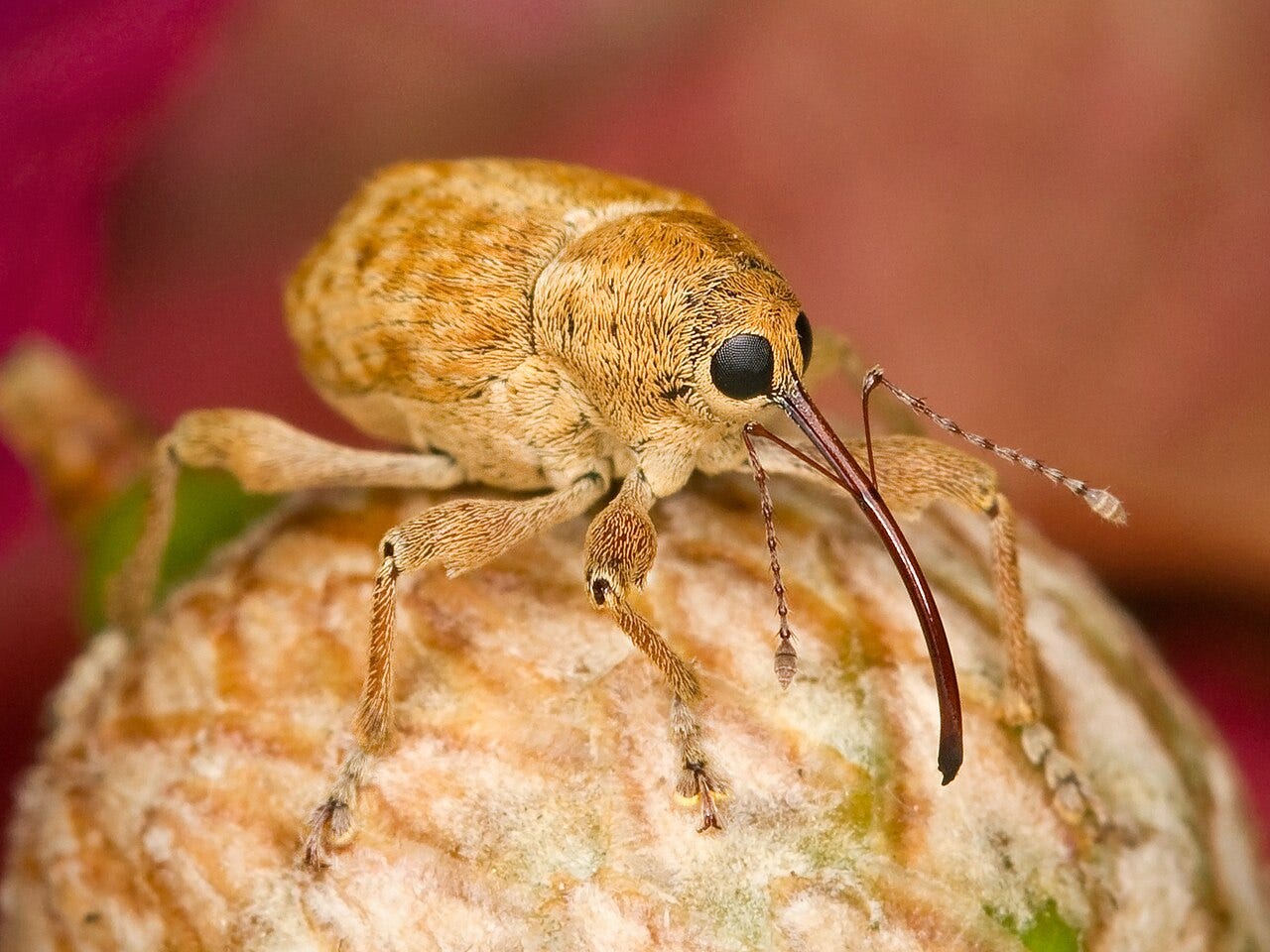
The acorn weevil is a tiny beetle with a long snout. The female uses that snout like a drill to bore a microscopic hole into a developing acorn. Then she lays one or more eggs inside and plugs the hole with one of her droppings, called frass.

As the acorn ripens, the eggs hatch into tiny, legless grubs who devour the dense, nutritious kernel. As the kernel breaks down, the acorn loses water vapor and draws in air; the grubs’ growing bodies and the frass they produce weigh less than the original kernel. They finish eating the acorn contents in late fall or early winter, after the acorn has fallen to the ground.

The grub chews a perfectly round hole—about 1/8 inch in diameter—through the wall of the acorn, crawls out, and burrows into the soil for a year or two before pupating and emerging as an adult weevil who repeats the process.
The heaviest acorns are insect free. Using weight and probably some other cues, Blue Jays select healthy acorns with 88 percent accuracy. They can carry a few acorns in their throat pouch (technically, their gular pouch) and one or two more in their beak without causing any damage to the acorn.

They hide each acorn separately, tucking it into the soil and covering it with a leaf. That leaf does double duty, hiding the acorn to make it less likely that another jay or a squirrel will notice it, and keeping it moister, so if the jay doesn’t retrieve it, it’ll be even more likely to germinate. Because the jays hide each one individually, usually in an open area with loose soil, the spacing and sunlight give each one that germinates a better chance of surviving.
This is a perfect example of symbiosis—two species profiting by providing mutually-beneficial services. Oak trees produce huge numbers of acorns, but the heavy seeds drop almost directly below the branches they grew on where they’ll be too shaded and crowded to grow. But these acorns are an ideal food source for Blue Jays. Squirrels and chipmunks eat acorns, too, but they exploit the tree without nearly as much payback. Indeed, chipmunks hoard most of their acorns in their burrows, making it very unlikely that any of their stash will germinate. Squirrels “scatter hoard” many of their acorns in soil, as jays do, but they don’t select viable acorns with as much accuracy as jays, they tend to hide their acorns closer to the parent oak or other trees where each acorn will too shaded to thrive; and they often hide several acorns together in piles called middens, inhibiting germination and making the acorns more vulnerable to fungi. The two-way partnership between oaks and jays is much more helpful to the oaks.
When I was a licensed wildlife rehabber, I raised many baby Blue Jays and took care of several adults. It was fun watching them hoard things in the house—they’d tuck food (peanuts, sunflower seeds, and acorns) and toys (legos, buttons, coins, and other little items) in the folded crevices of our draperies and spaces between the cushions of our sofa, under the edges of area rugs, and inside the loose legos and other things in our toy box and the “lego drawer” in our play area. Sometimes they’d go back and retrieve them, eating food items and tucking toys in new places. They engaged in this as children play, seeming to genuinely enjoy hiding and retrieving things.

During the time I had my education Blue Jay Sneakers, we raised a baby squirrel we called Chuckie. When Chuckie was little, and then after she became a neighborhood squirrel with indoor privileges, she’d hide peanuts and acorns in the same general places Sneakers did, and they’d both dig up each other’s food items, eating them on the spot or hiding them elsewhere. Chuckie’s focus was always food-related, while Sneakers really seemed to do it more for fun, hiding and retrieving legos with as much alacrity as she did food. An activity that gives pleasure in the doing with the bonus of providing a reliable food source later is great for the jays, and because it is so seemingly pleasurable that they hide up to 5,000 acorns each fall, way more than they’re likely to need over the winter, the ones never retrieved are great for the oak population.
Of course, it is possible that jays forget some of their hiding places, but no one has ever proven that or even conducted a study that suggests that. It’s much more likely that they hide more than they need as insurance than that they’re forgetful.
Food, fresh off the tree or cached for later, is just one way that Blue Jays profit from oak trees. It may take between 20 and 50 years for a just-sprouted oak to mature and produce acorns, well beyond the average lifespan of virtually all jays.1 But every spring and summer, baby oaks just two or three years old already harbor caterpillars vital for Blue Jay nestlings, so a great many Blue Jays may reap rewards from the oaks they themselves planted beyond the value of cached acorns. And by the time an oak is 10 or 15 years old, it’s large enough to furnish favored nesting sites. That is within the lifespan of a good number of jays,2 so it’s probably not too uncommon for an individual jay to nest in a tree that he or she planted.
Do Blue Jays think all this through? We have no idea, but it’s unscientific to attribute to “forgetfulness” the many oak trees sprouted from acorns cached by Blue Jays. Did they leave those acorns “unwittingly”? That, too, is an unscientific judgment. The complex, mutually beneficial relationship between jays and oaks deserves more respect. Symbiosis is a lovely thing.
According to the Bird Banding Laboratory’s “Historical Longevity Records of North American Birds,” one banded Blue Jay in eastern Canada (sex unknown) survived 26 years 11 months, so it was old enough that it may well have fed on acorns from a tree it planted. (It tied getting entangled in fishing line.)
According to the Bird Banding Laboratory’s “Historical Longevity Records of North American Birds,” at least five banded Blue Jays have survived between 15 and 17 ½ years.

