

Get the Lead Out!
The Trump administration wants to move backward with regard to protecting wildlife and human beings from lead poisoning.

(I’ll link to the four-part the radio version here tomorrow.)

A Brief History of Lead
When I started producing “For the Birds” in 1986, there were no restrictions whatsoever on lead in ammunition and tackle for hunting and fishing, even though lead had been known for a long time to be a dangerous neurotoxin. Lead can be smelted from galena—its widely distributed ore—in an ordinary wood fire, so people in ancient cultures were quick to discover many uses for it in tools, cookware, and even such things as kohl, an eye cosmetic we now realize is toxic. Ancient Egyptians applied kohl around their eyes to reduce the glare of the desert sun and to repel flies who, unlike the ostensibly most intelligent species on the planet, were smart enough to avoid contact with it.
Flies, unlike the ostensibly most intelligent species on the planet, were smart enough to avoid contact with lead.
Both the chemical symbol for lead, Pb, and the word plumbing are derived from the Latin plumbeum, because lead was used to make early Roman water pipes. It’s cheap, malleable and easy to work with, durable, and doesn’t rust. Virtually all plumbing in American cities and towns, from water mains to the pipes inside houses, was made with lead well into the twentieth century.
My house was built around 1910 or so. The inside pipes had been upgraded before we moved here in 1981, but after we’d been here a few years, Russ suddenly realized that the line from the city’s water main to our house was lead.

At the time, I was pregnant with Tommy, Katie was a toddler, and Joey was little, so we immediately pressured the city to replace it, mostly at our expense. It probably didn’t cause any harm, but why risk it? It wasn’t until the horrifying situation in Flint, Michigan, that municipalities started getting serious about lead water mains and pipes. Duluth is still in the process of replacing the old system, little by little.
It’s not as if people in the mid-1900s were unaware of the danger of lead pipes—Australia banned lead service lines carrying water to households in 1930. But despite the known dangers, new service lines could legally be made of lead in the U.S. until a provision of the Clean Water Act finally banned it in 1987. Before that, some localities actually mandated the use of lead in service lines, primarily due to lobbying by lead manufacturers and plumbing unions. Small wonder that several nuns at my Catholic school called money “filthy lucre.”
As bad as lead plumbing was, even more dangerous for ancient Romans was pewter tableware. Polished pewter was almost as beautiful as silver but much cheaper, so it was very popular with the middle class in Rome, and lead was a standard component. Wine is acidic, readily leaching lead from pewter goblets or jugs. Vintage pewter is usually about 15 percent lead but can be as much as 40 percent, and it wasn’t until the 1970s that the U.S. started phasing out the use of lead in pewter, so it’s dangerous to serve food or drink in pewter unless you are certain it was made after 1974.
Even worse than eating and drinking from pewter tableware was leaden cookware. Ancient Romans boiled down grapes to make a sweetener called sapa, inadvertently concentrating lead acetate in their food and wine. Lead is especially dangerous for babies, children, and pregnant women, and we’ve known for a long time that exposure to it contributes to cognitive decline, infertility, and erratic behavior in people of all ages; many historians consider lead toxicity to be one of several contributing factors leading to the fall of the Roman Empire. I can’t help but wonder if lead toxicity is a contributing factor in the cognitive decline and erratic behavior of many Americans. In researching this, I read comments by antique collectors who insist they eat and drink from old pewter all the time and have never felt ill effects. Few of us notice a very gradual cognitive decline, temporary or permanent, due to aging, dehydration, illness, drug use, brain worms, or the slow bioaccumulation of lead, even when it starts impairing our judgement about serious matters.
Lead was used in paints in residential housing in the U.S. until 1978. The purpose was primarily to speed up drying times, increase overall durability, and improve resistance to moisture and weathering. Also, some lead compounds such as white lead served as a premium pigment, providing a brilliant color, high opacity, and a smooth finish. The dry weight of indoor paints was at least 10 percent lead, and outdoor paints as much as 50 percent.
In the 1950s, my little brother often swallowed paint chips from our dining room windowsill. My mother thought it was no problem because the windowsill was clean. That poor child suffered cognitive problems his whole life and was functionally illiterate, but there were many compounding factors—he was premature, weighing less than 4 pounds when he was born in 1955; he was shunted off to first grade when he was three months shy of 6 years old and always struggled in school; and he was introduced to drugs at a young age, quite likely by our parish priest—but those leaden paint chips certainly didn’t help.
As it ages, lead paint doesn’t only chip and crack—it also “chalks,” releasing toxic dust, so anyone exposed to the air around old paint is likely to be breathing in some lead. Houses built after 1978 are extremely unlikely to have any lead paint, but a great many houses built before then still have exposed lead paint in areas that aren’t often redecorated, such as closets, attics, and basements. In most very old houses like mine, virtually all the old lead paint was painted over or wallpapered multiple times, so all the lead has been trapped, at least until remodeling or sanding, when it can be released into the air.
Gasoline used to be leaded; as it combusted, the lead was released into the air, most eventually working its way into surface water, soil, and groundwater. One of my vivid childhood memories was how quickly fresh snow along roadsides turned black and crusty due to the lead and other particulates in car exhaust. Lots of moneyed interests, including Standard Oil, General Motors, and the Ethyl Corporation (a lead-additive manufacturer), fought against regulating leaded fuel, but with the national focus on pollution after the first Earth Day, there was enough political pressure for Congress to start requiring catalytic converters on cars to meet new emissions standards. Leaded gasoline permanently damages catalytic converters, so all cars built after 1975 were required to have a smaller filler neck to the gas tank, which accommodates only the narrower lead-free gas pump nozzles.
Leaded gasoline was entirely banned for on-road vehicles in 1996, though it is still available for some highly restricted uses, and lead is still a component of car batteries, x-ray shielding, many electronics, solder, and plenty of other things. Without strenuous regulations and enforcement, it readily leaches into ground and surface water at landfills.
How Lead in Ammunition Harms Humans
Imagine spewing thousands of tons of mercury, cyanide, or other known toxins into the environment every year in the name of sport. In the United States alone, an estimated 80,000 tons of lead are deposited annually at shooting ranges alone. This concentrated lead slowly seeps into lakes, rivers, streams, and groundwater. Lead contamination from one California shooting range made its way to a nearby stream, leading to a documented decline in fish populations. We can guess how lead contamination affects humans near shooting ranges, but it’s extremely difficult to track, there is political opposition to studying it, and very few problems with regard to the health of individuals or populations can be attributed to any single cause. For example, my older brother routinely followed the DDT truck as a kid and then was exposed to Agent Orange in Vietnam. A few years after he came home from the war, he developed weird subcutaneous lumps all over his body and then developed cancer in his 50s, but the VA did not help him. In our system, if one harmful entity can prove a second harmful entity is also to blame, neither is held responsible. In a world filled with pesticides and other toxins, habitat degradation and loss, and all kinds of issues that harm wildlife, it’s easy for people to deflect blame for any problem on all manner of things.
The government makes some recommendations for shooting range operators with regard to adding lime or other alkaline materials to the soil to reduce acidity, providing erosion control, and occasionally sifting the soil and recycling lead particles, but these are all strictly voluntary. Without regulations and enforcement, tens of thousands more tons of lead will continue to rain down on shooting ranges every year.
In the 1980s, when I talked about hunters using non-toxic ammunition, I got ridiculed because, “like DUH, Laura, the whole point of ammo is to be lethal!” Few of them considered how vulnerable humans are to ingesting lead directly from game meat. It’s hard to find and cut out all the lead shot in a duck, quail, dove, or other small animal. A tiny amount may leach into the meat as it cooks, and some pellets may end up in someone’s mouth. Older children and adults usually spit them out, but younger children—the ones most vulnerable to the worst, most long-lasting effects of lead poisoning—are more likely to swallow them. Pellets work their way through our digestive system and out, but the acidic juices in our stomach dissolve some of it, sending it into the bloodstream.

Small animals taken with shotguns aren’t nearly as big an issue for human health as the larger animals that are usually hunted with bullets. On impact, bullets and some buckshot fragment into smaller pieces; when shot from a high-powered rifle, bullets explode on impact in a “lead snowstorm”—the X-ray pattern formed when a bullet shatters into hundreds of tiny, dust-like metal fragments, many scattering several inches from the primary wound channel. This effect is most commonly produced by high-velocity hunting ammunition or unjacketed lead rounds striking tissue or bone. Now that we know this, many food shelves no longer accept game from hunters. The children of many deer hunters get no such protection.
The Minnesota and Wisconsin DNRs, and probably many others, have worked hard to educate hunters about how dangerous lead is for people eating game meat, but a great many hunters ignore these warnings. It can be hard to give up the rifle or shotgun handed down from a beloved father or grandpa for one that can handle non-lead ammo, or to accept that a family tradition going back many generations has a dark side. Right now, our country is so divided, with so much anger and suspicion towards anyone with different opinions about a variety of issues, that many people sincerely believe that anything environmentalists say must be wrong. To this day, against their own self-interest as well as the health of their families and friends, many hunters and hunting organizations as well as the NRA fight vigorously against restrictions on lead ammo.
How Lead in Ammunition and Tackle Harms Wildlife
Eliminating lead from ammunition is clearly in the best interest of humans, but it is even more vital for wildlife, including the game species hunters claim to do such a great job of conserving. The vast bulk of the lead shot used for hunting each year in the United States doesn’t touch the target—even in successful hits, there’s always some literal scattershot that falls to the land or water below. Many upland game birds, including doves, pheasants, turkeys, quail, and prairie chickens, as well as non-game songbirds, pick up grit, including lead pellets, from the soil, to help their gizzards grind up food. Bottom-feeding and predatory fish such as largemouth bass, trout, and carp, as well as waterfowl, do the same thing, picking up and swallowing tiny stones, lead pellets, and grit in the muck at the bottom of lakes, rivers, and streams. And any fish who swallow lead tackle but get away are also subject to lead toxicity. In all these cases, the lead bioaccumulates in their bodies.
Experts learned in the 1950s that about two million waterfowl were dying every year from lead poisoning, yet the NRA and many hunters fought vigorously against prohibiting lead shot, even specifically for waterfowl hunting. Fortunately, at least some duck hunters understood that protecting ducks from lead was essential if they wanted to maintain sustainable numbers for the survival of their sport. This changed the political calculus, so starting in 1987, a federal ban on lead for waterfowl hunting was phased in, and by 1991, all waterfowl hunting nationwide was finally limited to non-lead shot. Despite this, lead shot continues to rain down on many wetlands because in most places, hunters are still allowed to use lead shot for hunting upland game, even when the small mammals and so-called “upland” birds are in a wetland.
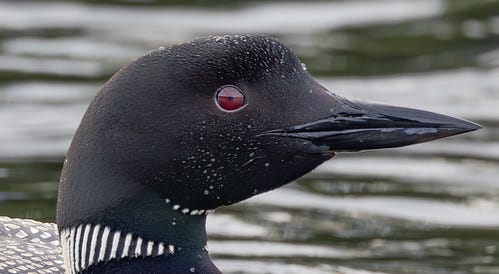
The harm to fish, birds, and mammals swallowing lead pellets and sinkers outright is only a fraction of the problem. Predators feeding on them and scavengers eating their carcasses also ingest lead. Fortunately for people who eat game fish, lead tends to settle in fish bones, scales, and internal organs rather than their meat; it’s the animals who swallow fish whole, such as loons and herons, and those who eat big chunks of the fish, such as Bald Eagles and Osprey, who ingest significant quantities of lead from contaminated fish.

Bald and Golden Eagles and ravens scavenge on deer and other large game that was hit by gunshot but eluded the hunter before dying, and on the gut piles of those that didn’t get away. Every year, the Raptor Center, REGI, and other rehab facilities nationwide treat distressing numbers of Bald Eagles, the number spiking during deer hunting season, and most of the eagles admitted suffer from severe lead poisoning. In a ground-breaking study published conducted between 2010 and 2018 by the US Fish and Wildlife Service and US Geological Survey, researchers collected blood samples from over 600 live Bald and Golden Eagles and liver, femur, and feather samples from almost 600 dead Bald and Golden Eagles over all four seasons in 38 states representing all four flyways; almost 50 percent of the eagles they sampled showed evidence of repeated exposure to lead.

In 1986, the year I started producing “For the Birds,” every California Condor in existence was brought into captivity, and every single one of them was suffering from very high blood levels. We started reintroducing them back to the wild in 1992, and conservationists worked tirelessly to keep them from ingesting lead by working with farmers and ranchers to dispose of safe carcasses in special condor feeding areas. But hunting is popular in California, a state with a robust “varmint hunting” tradition, too. In addition to all the ways lead ammo harms wildlife, California hunters can shoot coyotes, ground squirrels, and jackrabbits without limit and without collecting the carcasses, so condors were still ingesting high levels of lead.
Moving Forward, and Now Backward
In 2007, while he was governor of California, Arnold Schwartzenegger signed into law a regulation prohibiting lead ammo in the 8 counties (out of 58) where California Condors were most common, but the poor birds cross county lines all the time, so the problem continued. In 2013, Governor Jerry Brown signed a law that phased out lead ammo for all hunting everywhere in the state, and on July 1, 2019, the ban reached its final stage. Now all firearm hunting with lead ammunition is prohibited. The NRA absolutely opposes this law, brazenly claiming despite an abundance of data that “Traditional ammunition does not and has not negatively impacted wildlife populations in North America and is far more effective and affordable for American hunters.”
Starting in 2009, the Obama administration started working on a rule prohibiting the use of all lead ammo and fishing tackle on all 573 national wildlife refuges. It took until January 17, 2017 for the rule to take effect, but on March 2, 2017, the Trump administration rescinded it.
In 2023, the Biden administration finalized a rule mandating the use of non-lead ammunition for all hunting on just 8 of the nation’s national wildlife refuges. The rule was to take effect on September 1, 2026, but now the Trump administration is reversing this, with the full support of the NRA, a great many hunters, and even Ducks Unlimited, an organization revered by many for its focus on conservation. The organization claims that it’s too complicated and unfair to have different rules at different refuges even as they say a nationwide rule can’t be justified because we need scientific studies to prove the harm on such a wide scale, apparently ignoring that ground-breaking study that showed that almost half of a large sample of eagles, from 38 states representing all four flyways, were carrying unacceptable loads of lead.
Ignoring research for political gain is one thing—now a new proposal by the Trump administration will add political appointees to all committees that approve government research and grants. This will ensure that politics and big money interests will always trump scientific truth, whether the environment or human health is at stake.

I know a few hunters who have switched to non-toxic ammo to protect themselves and their families yet insist that using or not using lead should be a personal decision, not a dictate from “the nanny state.” They say that it’s emotional, not rational, to consider the suffering that eagles and other victims of lead poisoning endure, even as most arguments defending lead ammo and tackle are emotional, revolving around nostalgia and tradition.
Hunters and anglers who oppose restrictions on lead ammo and tackle are exactly like those who opposed hunting licenses, bag limits, open and closed seasons, and the other restrictions that have, since the time of Theodore Roosevelt, ensured that the game species hunters and anglers enjoy can thrive long into the future. As long as any hunters or anglers claim a right to spew toxic lead into our environment, they’ve squandered the right to call themselves conservationists.


I just started a “Buy me a coffee” thing for people who want to support my work but don’t want to pay for a Substack subscription. I am absolutely committed to providing all my content for free to anyone who wants to read it, and am very grateful to Substack for letting me do that, and for my paying subscribers for getting my gross income up barely into 5-digit territory. But every little bit of support helps! You can give a one-time tip for as little as $1 if you click on the button.)