

Home from Ecuador!
A quick trip summary followed by a Katie/Katherine update

(Listen to the radio version here.)

I’m starting to write this while riding in a big, comfortable bus with ten other people—Omar the kind and helpful driver; Edy Goodyear, owner and lead guide for Sword Billed Expeditions; and eight people who, like me, have been on an 11-day tour to see and photograph Ecuador’s splendid birds.
At this very moment, we’re heading northwest. We’re south of but close to the equator, at 6,750 feet in elevation, on our last drive together, not to a birding destination but to the airport in Quito. Just this morning we were birding down at 1,386 feet, and yesterday we were even lower by the Napo River, a tributary of the Amazon.
The highest elevation I noticed was 11,400 feet, while we were in the high Andes. During the few days we were up high, I took medication to ward off altitude sickness. I’d never suffered from it before, but I’ve also never spent so much time so high up before. Climbing and even walking on level ground were utterly depleting up there. Fortunately, the climbing we did was in hopes of seeing an Andean Condor soaking in the early morning sun for an hour or two before taking off. The bird was wonderfully cooperative, so the payoff was far, far greater than the exhaustion.

I consider myself much more a birder than a photographer, but my binoculars got surprisingly little use on this trip. Edy Goodyear planned out our itinerary to take us to places where we could see almost all the birds up close and personal, so it was my camera that got the workout. At every place we stopped, Edy got us all in position for great camera angles and gave hints on the best camera settings for these conditions before he started taking his own pictures. It’ll take me weeks—maybe months—to work through all the photos I took on the trip. I took 26,915 on my good camera (I am not making that up!) and a lot on my cellphone, too. I’ll of course delete the vast majority of them, but working through the good ones will take time.
Since December 10, our group has seen or heard 406 species of birds, of which 130 were lifers for me. I saw the one bird at the very top of my “most wanted” list—that Andean Condor. And I got to enjoy several of my most beloved birds—the Andean Cock-of-the-rock…

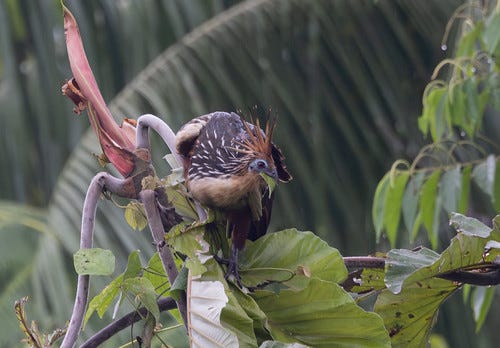
… Hoatzin….
…and two birds I fell in love with on my first trip to Costa Rica—the Green Thorntail…

…and adorable Rufous-collared Sparrow.

While studying the field guide before my first tropical trip in 2001, I fell in love with antpittas—extremely secretive tropical skulkers with very long legs. An innocent look about them combined with their tiny stub of a tail makes them look like adorably oversized baby birds. Antpittas have loud calls, but even when one is very close, it’s extremely difficult to see—they usually stay deep in the foliage. So imagine my surprise and delight to get good photos of ten different species on this trip! They’ll be getting their very own post soon.
Now the bus windows are steaming up—we’ve reached 11,400 feet with a ways to go, and just sitting in the bus, my breathing is getting a little labored.
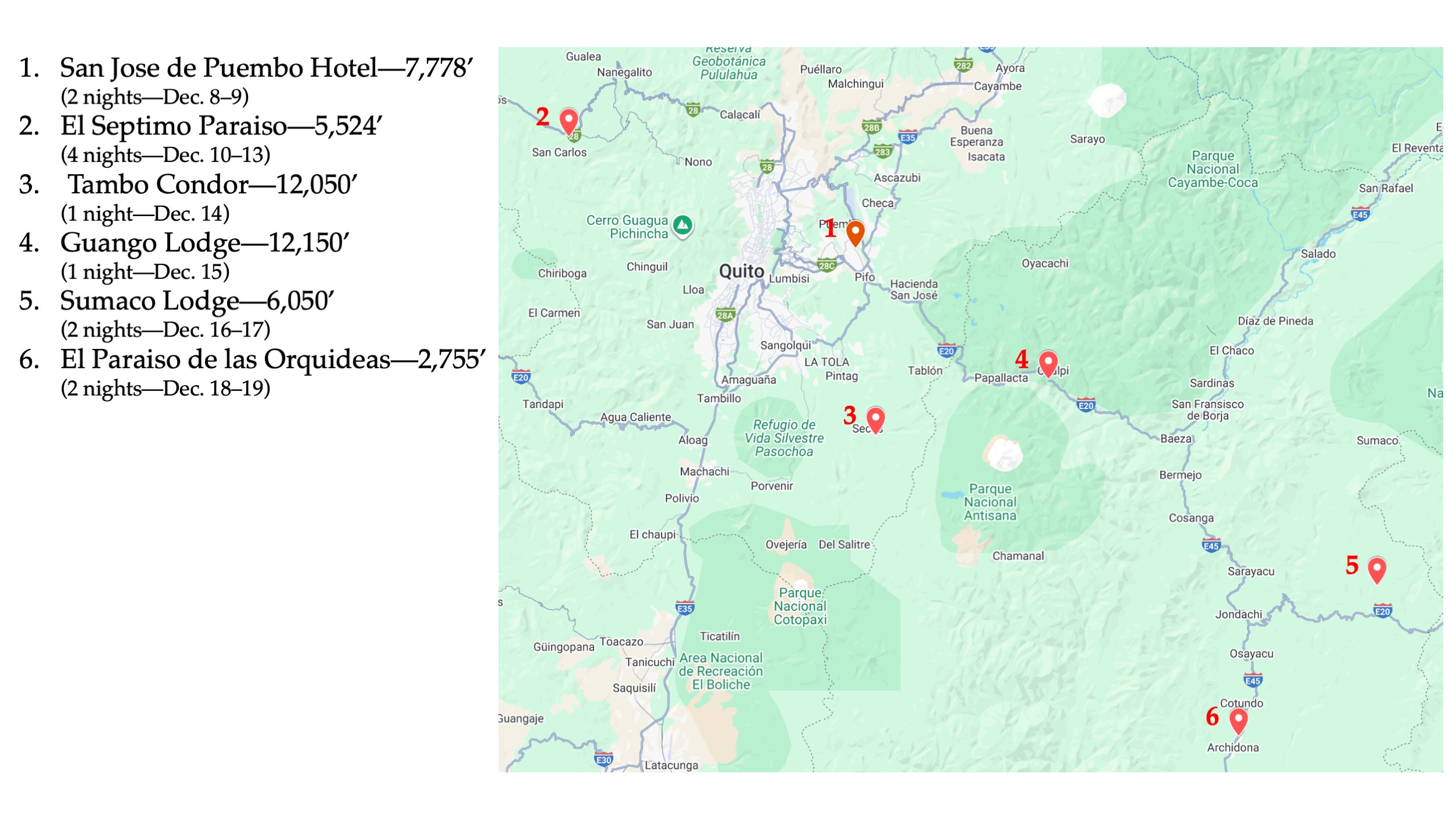
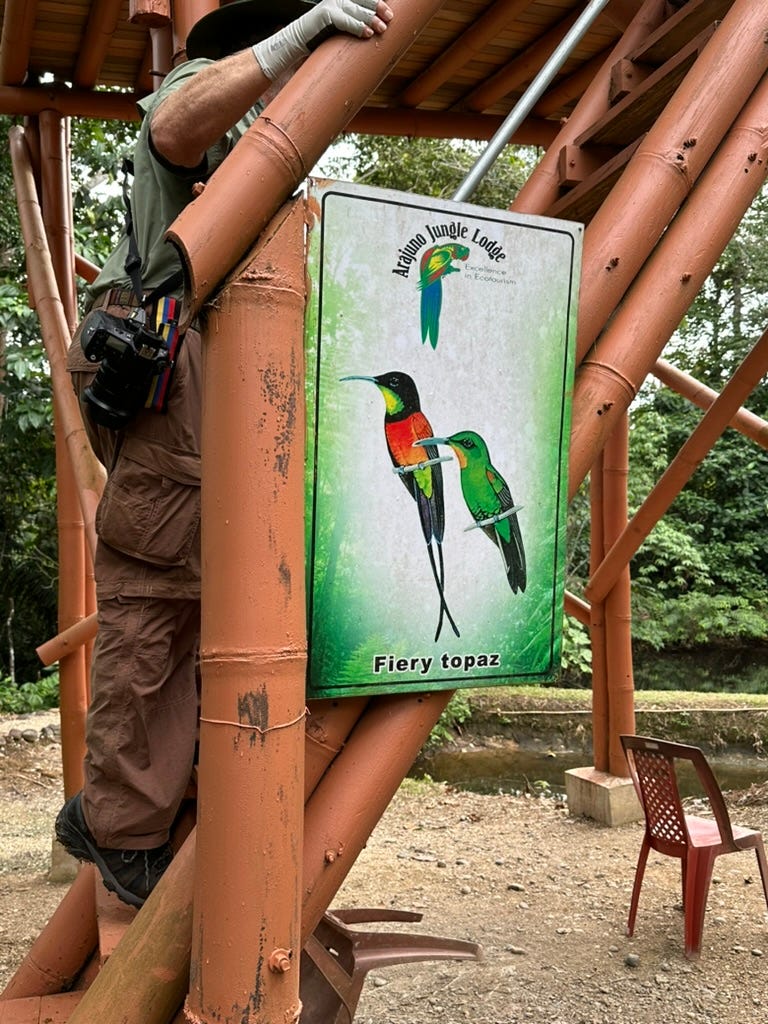
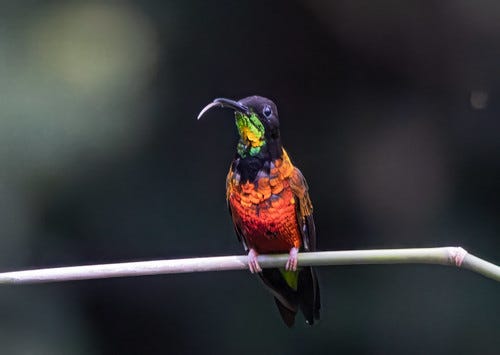
Edy planned this trip very well to help us adjust to the huge variation in elevations, taking us first west of Quito to spend four days centered around a lodge that was about 5,500 feet before bringing us to high ground. After two nights at very high elevations, we eased our way down for the final two nights, giving us a chance to see both that Hoatzin and the spectacular Fiery Topaz.

After our splendid condor encounter, we did one touristy thing that didn’t involve birds: we visited a museum near Quito where we could get our picture straddling both hemispheres directly on the equator.
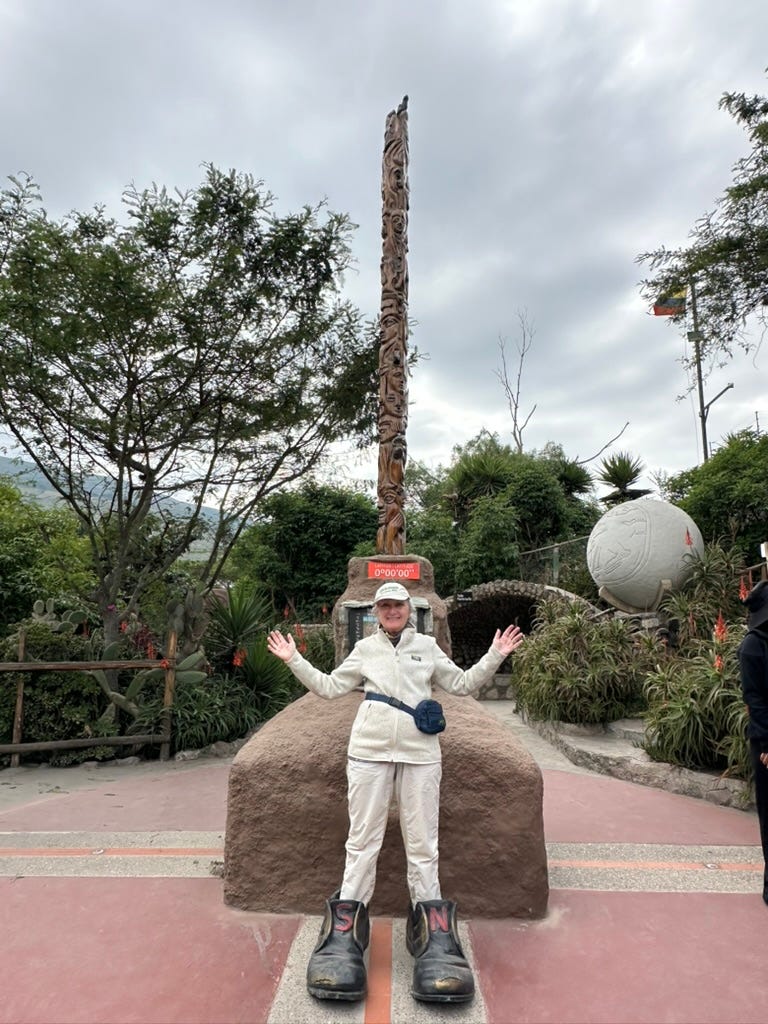
The museum has a globe with the axis set horizontally, and our wonderful tour guide had half of us stand facing the southern hemisphere and half facing the northern. When she spun the globe as the earth turns, from west to east, those of us facing the southern hemisphere saw the spin as clockwise while those facing the northern hemisphere saw the spin as counterclockwise. I wish I’d seen this kind of demonstration when I was a science teacher back in the 70s—I could have made the Coriolis effect much, much more understandable for my students.
Then our guide set a large basin directly on the equator, filled it with water and a floating leaf, and let the water settle. When she pulled the plug, the water went straight down as did the leaf, without forming any whirlpool. When she did the same thing several feet south of the equator, a clockwise whirlpool formed; on the northern side, it spun counterclockwise. This Coriolis effect explains why storm systems north of the equator rotate counterclockwise and those south of the equator rotate clockwise. It also explains why those kinds of weather systems are so very rare in Ecuador, where every place is so close to the equator. Ecuador specializes in downpours.
Now on this bus drive, we’re up at 13,000 feet and it’s weird to look out at a huge, snow-covered mountain peak towering much higher up than we are! Sadly, I can’t hold my phone steady enough to get a photo.
Even at the lowest elevations in the rainforest, I didn’t get a single insect bite. Oddly enough, the only unpleasant encounter with any critter on this entire trip was right here on the bus just before I started writing this. I’d fallen asleep and was awakened by a sharp stinging on my eyelid—I blearily reached up and flicked away what turned out to be some sort of insect. A bee or wasp? My photos turned out awful.
Of course, especially after making eye contact, I could hardly hurt the little guy. My eyelid got puffy but by the time we got to the airport, even the minor redness was gone.
We arrived at the airport very early—before 6 pm. My 11:45 flight was delayed until about 3 am, meaning I of course missed my connections. I rescheduled as quickly as I could in Quito, but instead of flying out of Atlanta about 9 am, my new flight left at 6 pm, and instead of arriving in Duluth in the morning, I got there at 10:30 pm.
One or two travel glitches are to be expected with any foreign trip, but such a relatively minor inconvenience will quickly be forgotten while the glorious birds I experienced will linger in my memory forever.

My daughter sent me lots of updates while I was in Ecuador. All the high risk mutations they tested for were negative, so they’re calling her “standard risk.” She’ll have an all-day appointment at the Mayo on December 31 so they will be arriving on December 29 so she and Michael can focus on putting together all their questions, and I’ll be down there to keep Walter busy for the duration. He knows his mommy has cancer, and that it’s in her blood and bones so they can’t cut it out the way they could my breast cancer. They’ll give her special medicines and treatments, instead.
When I wrote my last blogpost, I couldn’t bring myself to type the word “incurable.” I still can’t wrap my head around it, but it’s making me very bitter about DOGE and RFK Jr. and how government-sponsored medical research is vulnerable to the whims of greedy and mad men.
Fortunately, my Katie is focused on her spreadsheets—questions for doctors, treatment options, self-care issues during treatment, and all that. Not being plagued with her Irish mother’s temper, she focuses on more productive matters. She, Michael, and Walter are in New York for Christmas with Michael’s family. When they return, life will never get back to what I’ve always thought as normal, but knowing my daughter, the new normal she creates for all of us will be as good as it can possibly be.

Welcome home. It sounds like an amazing trip. So happy Katie will be treated at the Mayo Clinic. Outstanding place for myeloma treatment. Wishing you the happiest holidays possible! 💖💖💖 Susan K.