Monofilament
Still a clear and present danger to birds

(Listen to the radio version here.)
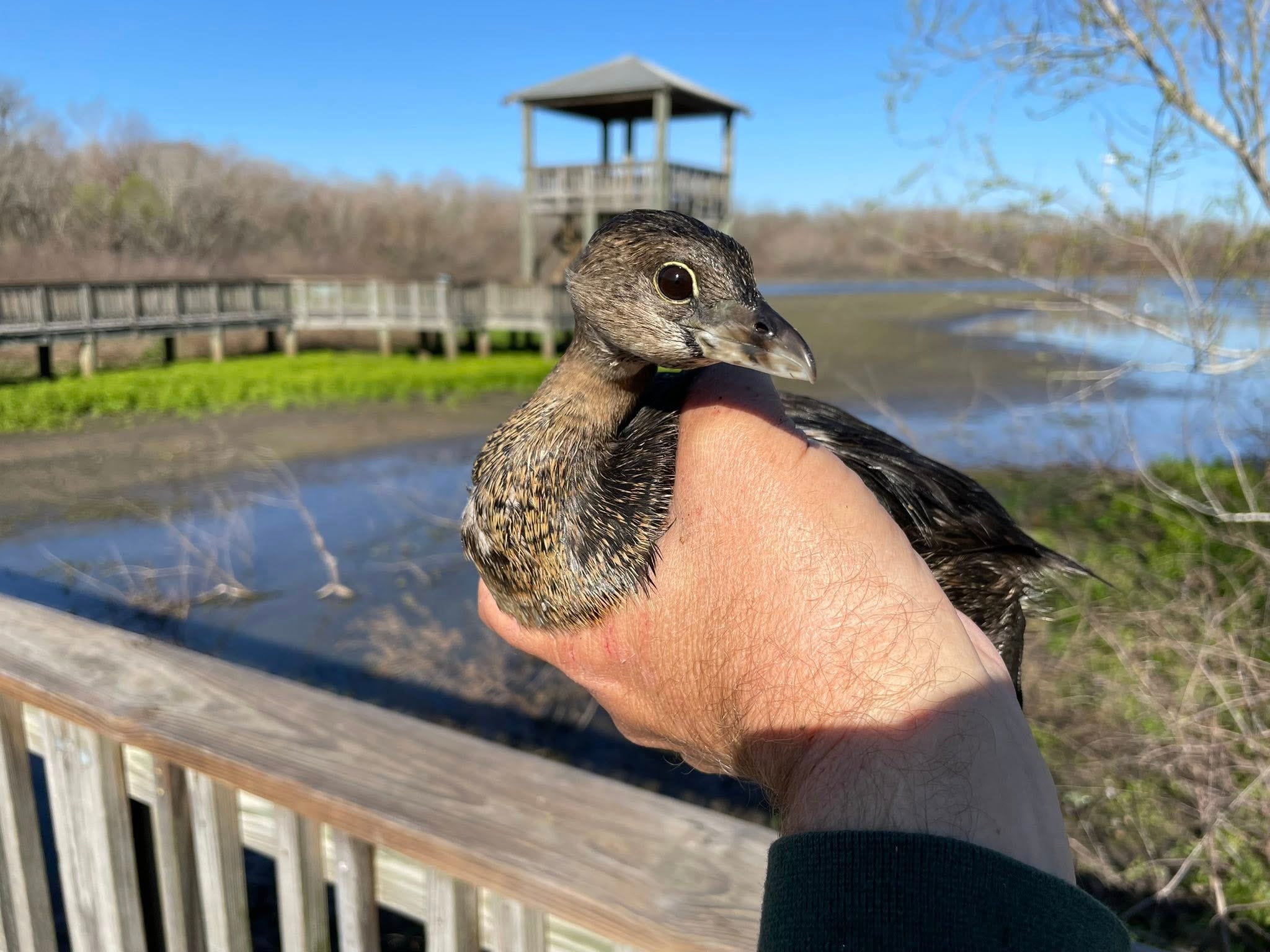
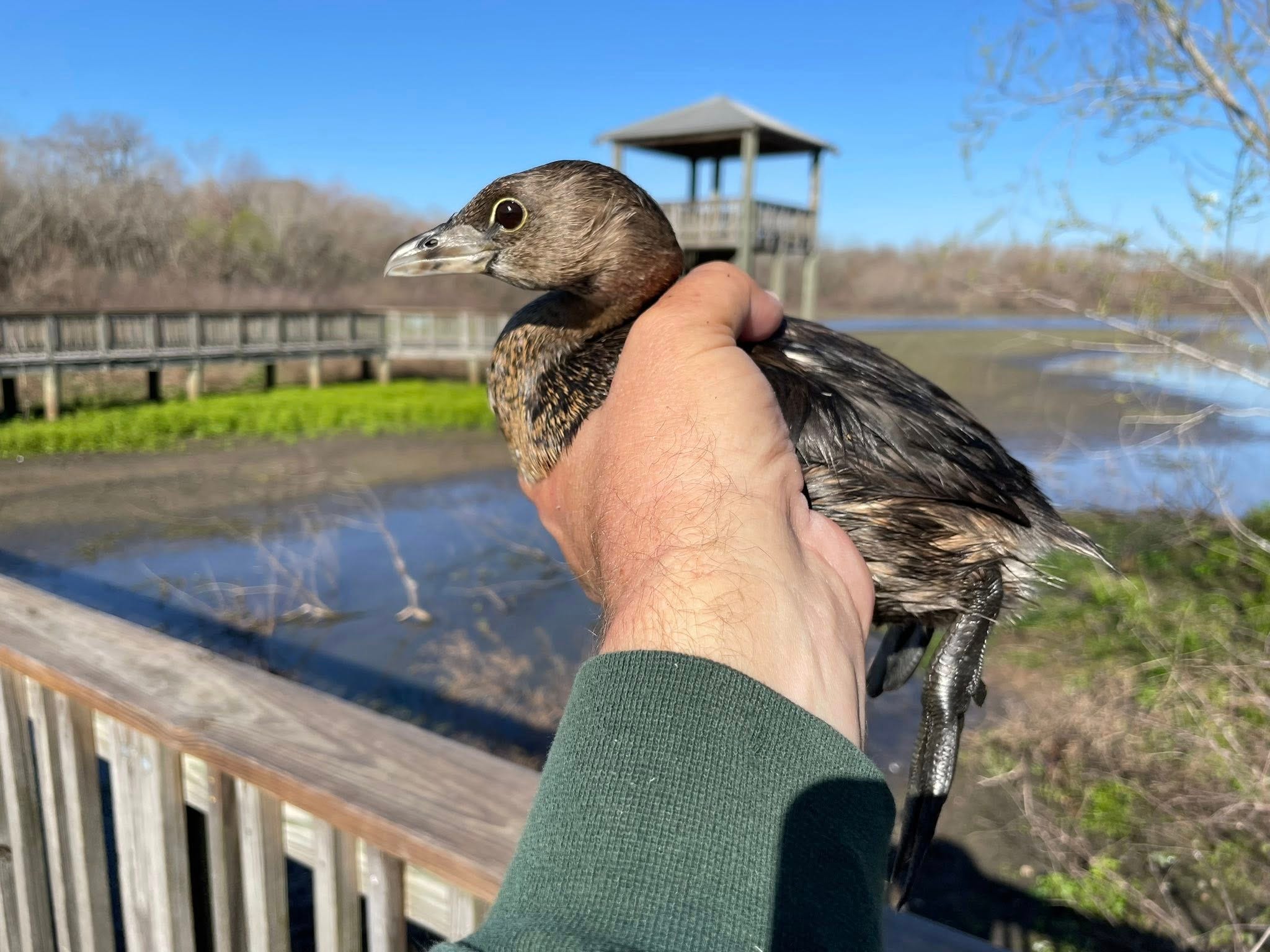
The splendid bird photographer Greg Lavaty is one of my friends on Facebook. This week, he posted a photo of a Pied-billed Grebe he was holding in his hand just before he released it at a popular birding spot in Sugar Land, Texas. He wrote:
I had a close encounter with a grebe this morning at Cullinan. Just as I was about to leave I noticed the bird struggling in the vegetation next to the boardwalk and on closer inspection I saw that it was tangled up in fishing line. After considerable effort I was able to get ahold of the line and haul the bird out. I was thanked with a considerable amount of biting—that beak is sharp and the bite is surprisingly strong. Some nice people showed up and they had a small pair of scissors which allowed us to free the grebe from its tangle. What a thrill it is to see the bird swimming free once again.
Greg’s story brought to mind one of my own encounters with a Pied-billed Grebe back in 1998. Some kids heard thrashing inside a trash bin at the Lester River Golf Course just a mile or so from my house. When they looked in, there was a Pied-billed Grebe completely entangled in fishing line. The bird clearly didn’t get into the trash barrel on its own—apparently, a golfer found it somewhere on the golf course and tossed it in the trash so it wouldn’t mess up a shot. Fortunately, the kids’ mom called for help in time. When I got the phone call, I charged right over.
Grebes are pretty much helpless on land, so they never waddle out of any body of water on their own. The best we could figure out was that the grebe got tangled while flying down into a pond—the line may have been caught on a branch or wire on the bird’s flight path and the poor little thing didn’t make it to the water, or the fishing line may have been partly in the water but tangled on something on shore. The grebe’s feet were abraded from struggling on land, but they weren’t bleeding and the bird didn’t feel emaciated, so after cutting off all the line, I brought it to nearby Brighton Beach and released it.
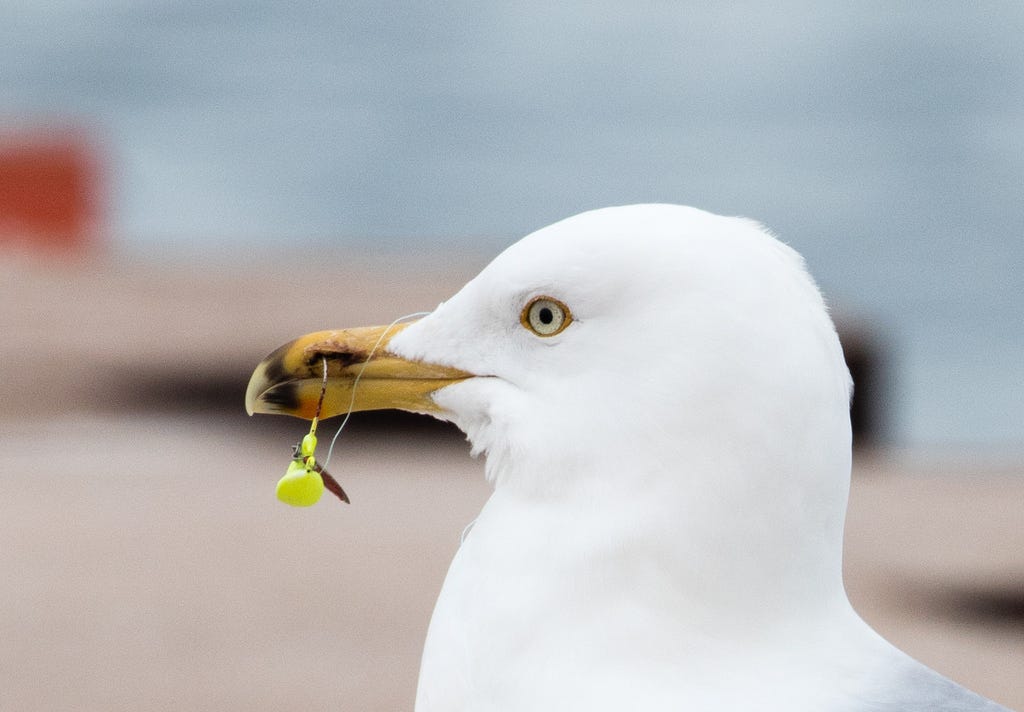
We’ve LONG known that fishing tackle is a clear and present danger for birds. I wrote about it in my 2006 book, 101 Ways to Help Birds (#69: Fish responsibly.) Over the years, I’ve seen at least a dozen dead birds caught in monofilament, suspended in trees and wires, and seen quite a few living birds with hooks stuck in their beaks. People once brought me a loon whose bill had been entangled in a wad of fishing line for so long that the tissue in and around its mouth was necrotic and the bird was critically emaciated. I sent it immediately to one of the best rehab facilities in the state, but there was no hope and it had to be euthanized.
I discovered the hard way that monofilament is also dangerous for people when I was birding alone at Anzalduas Park in Mission, Texas, and tripped on a wad of it, ripping my pants, bloodying my knees, and hurting my ankle. No one was around to help, but it could have been much worse. I managed to limp to my car, and the injury was on my left, not my right ankle, so I could still drive.
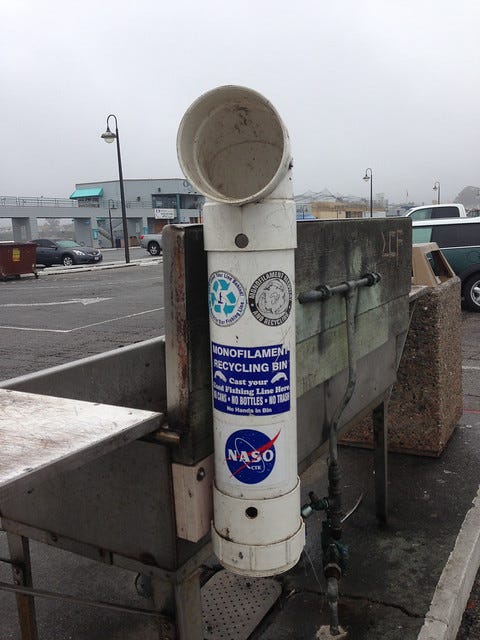
Most of the anglers I know are nice human beings, and I’m sure most of the tackle that ends up killing or injuring birds or people wasn’t left maliciously. But we humans—the one species on the planet whose numbers include rocket scientists and brain surgeons—sure don’t use our massive brains consistently. In several popular fishing places, I’ve seen conspicuous, clearly labeled monofilament disposal receptacles set up as Eagle Scout projects or by natural resources agencies, but believe it or not, I’ve picked up several wads of fishing line in full view of one of these receptacles.
There is absolutely no hope for the future if we people, individually and collectively, don’t start cleaning up our messes.