

My Favorite Bird
Making a Top Ten list is hard, but choosing #1 was a piece of cake.

(Listen to the radio version here.)

Trying to rank beloved people or birds on any Top Ten list falls somewhere between “prohibitively difficult” and “impossible.” Choosing favorites among birds feels akin to choosing favorites among my children—my connection to each is unique and special.
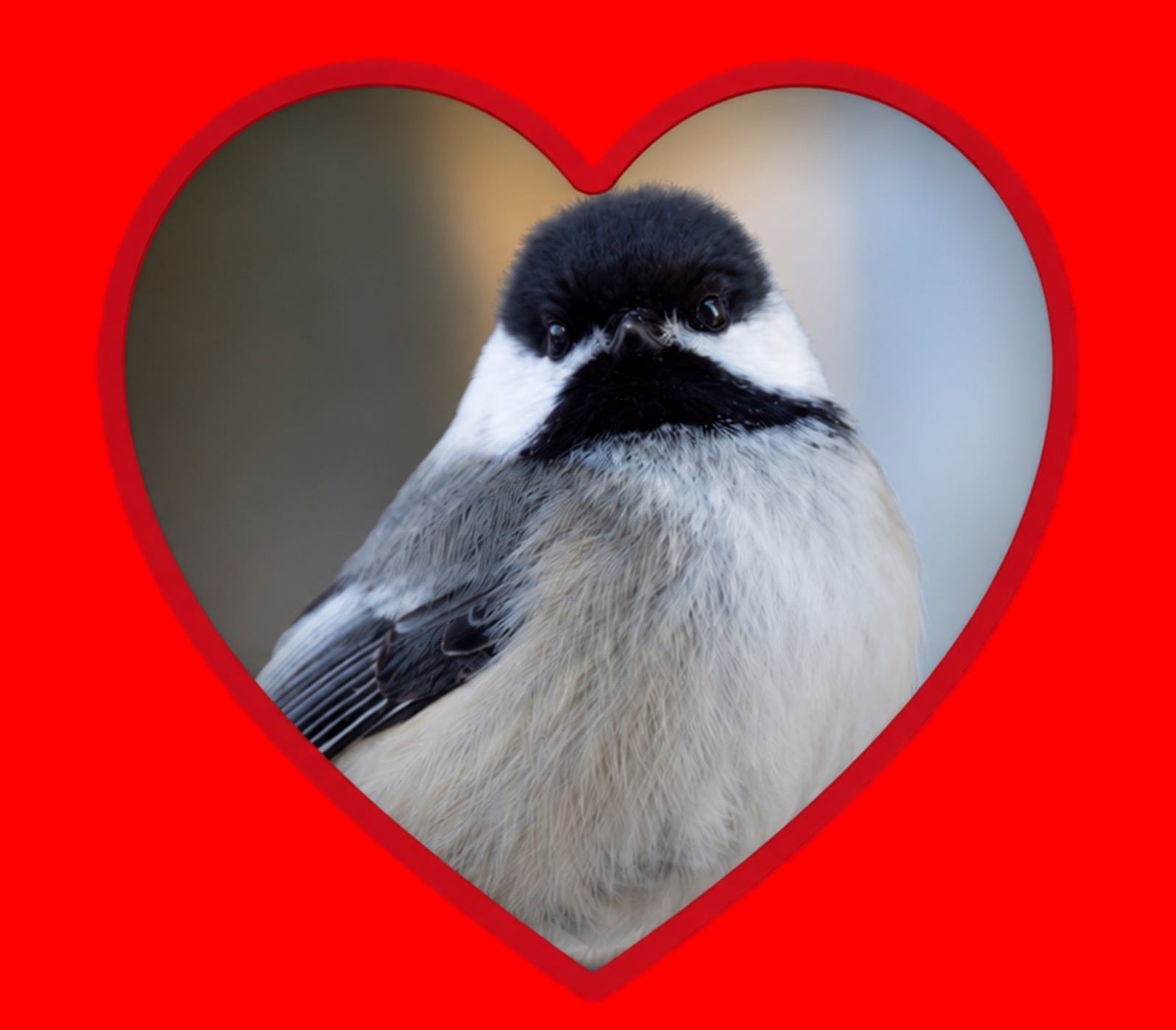
That said, the Black-capped Chickadee easily earned its place as my number one favorite bird because it’s the one that genuinely feels like part of my immediate family. The chickadee wasn’t just the first bird I ever saw when I started birding—to figure out what species it was, I had to spend quite a few minutes searching through my field guide, and the little bird was so cosmically obliging, not just staying within view but sticking close to me, posing from every angle, sometimes even making eye contact, as I figured out who it was. How could I not be smitten?

That entire first spring, chickadees didn’t just show up virtually every time I went out—they also seemed to bring friends for me to add to my life list, especially warblers.

I wasn’t at all surprised to learn that many small neotropical migrants associate with chickadees as they pass through strange areas—I’d seen firsthand that this was true.

When we moved to Duluth, chickadees were the first birds to visit my feeder and then to feed out of my hand.

One with a deformed bill and foot befriended me. He was obviously looking for literal handouts, but the confiding way he trusted me, looking in my window for me, alighting on my hand, and usually sitting right there so he could use my fingers to help him wedge the mealworm into position so he could manage to eat it warmed my heart.

The elongated upper bill broke off in the spring, and normal pecking action made the bill good as new. His deformed foot (he was missing the three front three toes on his right foot) still made him identifiable, and his frequent singing near my window confirmed that he was a male. He didn’t attract a mate that year but did the next, and they successfully raised young. I’ll never forget my joy and pride watching him feeding his babies and then watching the last ones fledge.


I worked at the Cornell Lab of Ornithology from 2010–2012, right when several scientists there were working on fascinating chickadee research projects. That’s when I got to watch them get banded.


I could check out their private parts…


…see inside their nests…


…and see exactly how such a friendly, confiding little bird is no wimp. Chickadees may willingly alight on our hands, but it’s strictly on their terms—they have a nasty bite when held against their will.

In 2021, when we were hunkered down at home during the pandemic, a pair of chickadees nested at eye-level in our dead cherry tree, giving me all kinds of opportunities to watch them excavate the cavity…


…build the nest within (well, I couldn’t peek inside a natural cavity!)…


…bring in the food for hungry babies…


…and carry out the fecal sacs.

They even let me make a video of the last one fledging.
And when the babies got skilled at flying, the parents frequently brought them to our yard while I was out there, giving me wonderful insights into chickadee family life.

Parent chickadees give almost all the food they find to those hungry mouths until by July or early August, when the young are finally independent, the parents are exhausted and bedraggled.

But with natural food everywhere, they quickly replace all those worn-out, year-old feathers with fresh new ones.
The backyard chickadees coming constantly to the feeder in my home office window caught my baby grandson’s eye, too. One of the very first words he learned was “dee dee.” Then, after he learned that his other grandmother was called “Nana,” he himself came up with the name “Dee Dee Nana” for me—the name he still calls me.

Those two old saws—“familiarity breeds contempt” and “absence makes the heart grow fonder”—don’t work for me. I guess a person who is still happy with the spouse she married in 1972 would of course have a special love for the bird who sticks with her every day the whole year round, personally engages with her, and genuinely seems to like her.
So in the same way that I have a special love for my husband, children, and grandchild, I have a special love for the Black-capped Chickadee, the bird who is and always will be Number One on my life list and in my heart.
Chickadees populate the dogwood tree outside my window, and in warmer weather, when I sit on the porch outside, they come to the bird feeder and look at me quizzically. Sometimes they issue their warning cry, as if I was about to eat them. But most often they just sit and stare. They're like my constant, smart, energetic little companions and I consider them friends. Thanks for your post.
Wonderful appreciation for those darling chicadees!