


(Listen to the radio version here.)

September is my favorite month.1 There are so many things to love about it. I look out my window to see my feeders crowded with Blue Jays; the back of my yard hopping with a variety of sparrows; a couple of American Redstarts flitting about flaring yellow or orange tail and wing markings; a Brown Creeper spiraling up my boxelder trunk; adorable kinglets flicking their wings as they catch tiny insects in the foliage; robins, a Swainson’s Thrush, Cedar Waxwings, and/or other fruit-eaters in dogwood, Virginia creeper, and mountain ash.

On September 18, 1989, I had a lovely visit with a Townsend’s Solitaire!

Even rarer birds show up in Duluth in September. The only time I’ve seen a Band-tailed Pigeon in Minnesota was at Hawk Ridge in September 1982. My only Vermilion Flycatcher in the state showed up on Park Point last September. And the only Northern Wheatear I’ve ever seen in my life showed up at Erie Pier in September 1995.
It’s not just birds that flood through in September. In addition to monarch butterflies and green darner dragonflies passing through at the start of the month, a bazillion birders gather in Duluth to enjoy the migration spectacle. Two of my most treasured friends from my time in Madison, Jon Peacock and Mike Myers, are proficient hawk watchers. They stayed with us a few times during Septembers in the 1980s and 90s, and this month showed up in Duluth again.
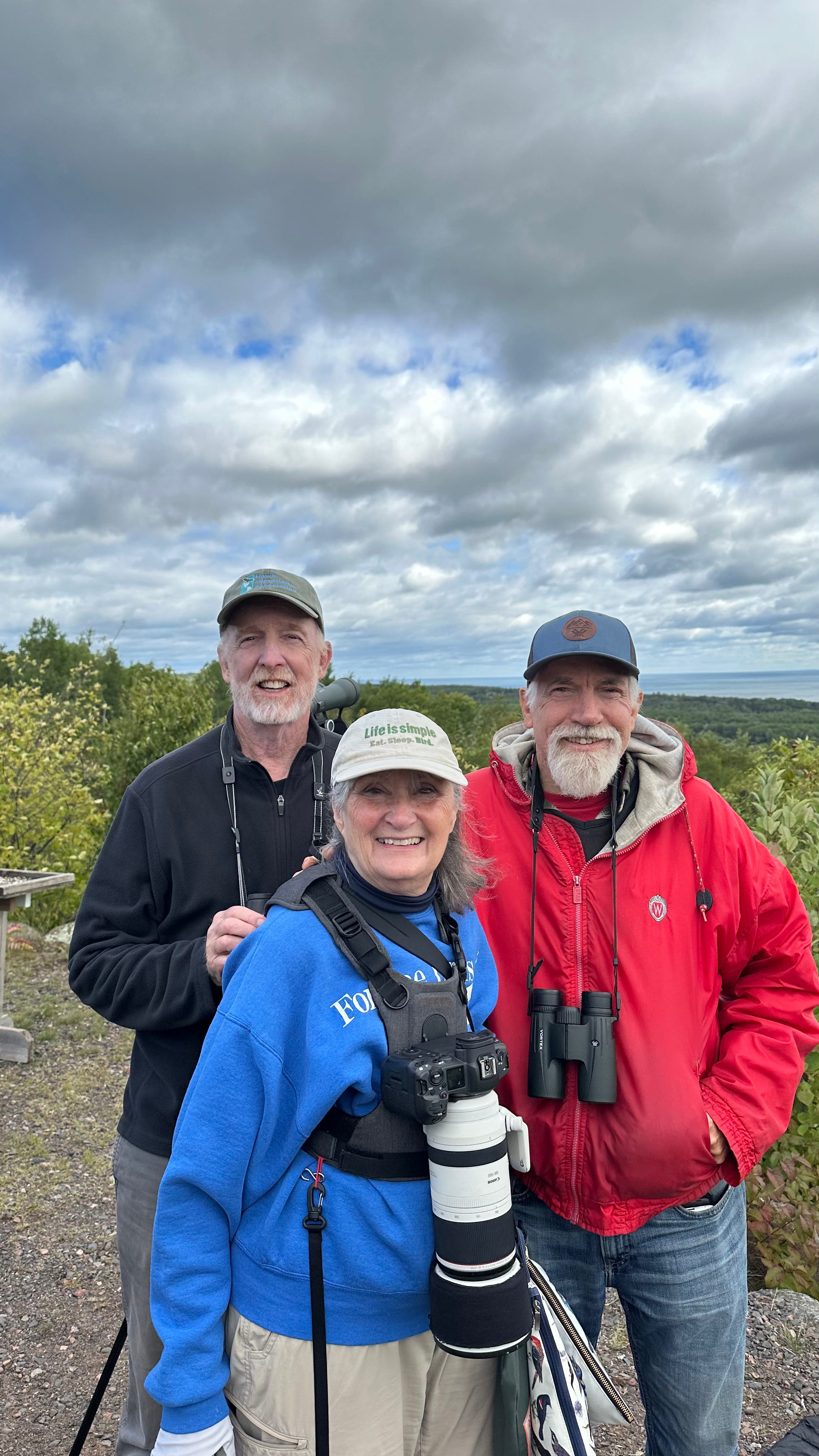
Up at the Ridge and taking part in activities during Hawk Ridge Weekend, I connected, as always, with a lot of other old and new friends. This kind of human companionship makes September special.
But we humans aren’t the only ones enjoying companionship this month. Robins have virtually all stopped singing, their territoriality over for the duration, and now they join sociable flocks to receive all the benefits multiple eyes and ears confer upon them as they pig out in fruiting trees and shrubs, roost together at night, and make their southward journey. Blackbirds, Cedar Waxwings, and Blue Jays also gather this way.

I’ve long paid attention to the Blue Jays in my yard and am always delighted with how peaceful they are as they crowd into my large tray feeder.

I was telling one of my friends last week that they “never fight,” when what to my wondering eyes should appear at that very moment but two Blue Jays duking it out! Never ever say “never” when talking about nature—birds have as much individuality as we humans do. If even the friendliest humans have their limits, why not Blue Jays?

Hawk watchers call swirling groups of buteos rising together on a thermal or updraft a kettle.

It’s easy to imagine that these kettles of hawks are sociable flocks, but nope—raptors tend to be solitary. Broad-winged Hawks and other hawks with a long way to travel are seeking out rising air currents. When they find one, they circle, the rising air carrying them upward in a spiral until the thermal reaches equilibrium with the surrounding air. At that point, the hawks set their wings to cover as much ground as possible, losing altitude until they find another thermal and repeat the process.
First thing in the morning, raptors must feel out where thermals and updrafts might be—often along shorelines and ridges or over patches of ground such as a highway, parking lot, or field next to a forest, where the ground is warmer than the surrounding air. But as some of them find thermals, others notice their spiraling flight pattern and head straight for that thermal, too.
Thermals grow in strength as the sun gets higher in the sky, carrying the raptors higher and higher above the landscape, making them visible from farther and farther away. By late morning and early afternoon, the numbers of hawks rising on a single thermal can number in the hundreds or, very rarely, thousands. But these birds are not being sociable any more than cars crowding on an interstate during rush hour are.
Most of the songbirds that migrate in flocks do their long-distance traveling by day, making it easy to for them to keep visual contact with one another.

Small neotropical migrants such as flycatchers, vireos, warblers, and tanagers mostly travel by night when temperatures are cooler, wind speeds lower, and raptors are sleeping. For the most part, these nocturnal migrants travel alone, but a great many can fill the sky on good migration nights, each one making little call notes to announce its presence, helping to prevent mid-air collisions.

When they come down to earth, these nocturnal migrants inevitably find themselves strangers in a strange land. Fortunately, wherever they are coming from in the north, they grew up with a homey sound that they are likely to pick up just about everywhere in the northern and central states, a sound that means some familiar birds will welcome them into their flock for the day, showing where the best food and water can be found and warning them about local predators. Next time I’ll talk about the birds who best exemplify real community values.


Well, okay, September is in an 8-way tie for first place along with January, April, May, June, July, August, and October.
I love the positivity and joy you find in the natural world. A welcome antidote to all of the negativity these days. I think it’s what keeps all sane!
I have never seen anywhere near that many jays together at one feeder—not even on the ground under a feeder. It’s just astonishing to see edge-to-edge blue like that!!!