


Listen to the much shortened radio version here.

I may have missed seeing an American Flamingo or Roseate Spoonbill when I was in Florida this month, and technically, this was a family trip, not a birding one, but I saw plenty of wonderful birds—about 70 species. I’ll sum them up with a Bird of the Day for the 8 days we were there.
OCTOBER 9: Northern Mockingbird

We arrived in early afternoon on Friday, October 9, and what with all the airport complications—getting our rental car, picking up a transponder for paying tolls, and getting our lodging straightened out, including an hour wait to check-in—this was not a birding day. We got to stay in a lovely resort thanks to my sister-in-law Jeanie, and it was a perfect place to loll around after the travel stuff was over. Right by their office, a mockingbird was singing away, and when we took a walk during the wait, we came across another one, again singing away.
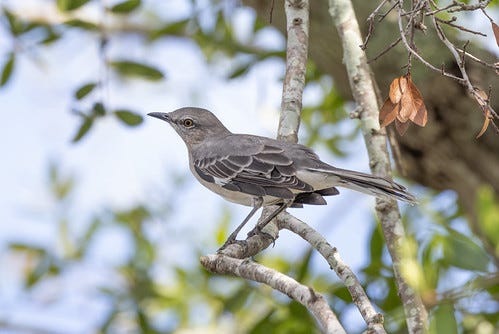
This being October, few birds were singing at all, but these guys were prolific, and their song was SO welcome—it made me think about Thomas Jefferson calling the mockingbird “a superior being in the form of a bird,” listing the species in his Notes on the State of Virginia, and boasting. after a trip to Europe, in a letter to Abigail Adams:
I heard there the Nightingale in all its perfection: and I do not hesitate to pronounce that in America it would be deemed a bird of the third rank only, our mockingbird, and fox-colored thrush1 being unquestionably superior to it.
Thomas Jefferson is so deeply embedded in the history of Virginia that it seems odd that the state bird of Virginia is not the mockingbird—it’s the cardinal. But at this very moment, Russ and I were in Florida, where the mockingbird is the state bird. 2
Russ and I drove past the resort office at least a couple times every day while we were in Orlando, and every single time, that mockingbird was singing. Tragically, I was so mentally zonked after the flight and everything that even though I took a bazillion photos, it didn’t occur to me to record him except for capturing his voice with one pretty marginal video.
But when we were at the Disney Wilderness Preserve (a splendid bit of habitat managed by The Nature Conservancy) on October 13, I did think to get a nice, long recording of a mockingbird. The only photo I took of that individual was nothing to write home about.
OCTOBER 10: Snail Kite

My son Joe is not at all a birder, but he was gracious enough to spend much of his birthday at Brinson Park and Kissimmee Lakefront Park—Lake Tohopekaliga is a magnet for two birds that are utterly dependent on apple snails—the Snail Kite and Limpkin.
I had to work very hard to add these species to my life list in 1988, searching for a Limpkin at the Anhinga Trail in Everglades National Park at night while Russ and the kids played games and listened to Raffi in the car—there were too many mosquitoes for them, and it wasn’t as if they actually wanted to see a Limpkin in the dark. The day before, Russ and the kids had lunch at the Miccosukee Indian Village restaurant on the Tamiami Trail while I stayed out in the parking lot, reportedly the best vantage spot at that time for seeing a Snail Kite. They ordered, ate, and then played around until I finally spotted one, too far away to see without binoculars. They’d kindly ordered a lunch for me to eat in the car after we left.
Now it’s an easy matter to see both species, not where they belong, in the Everglades where our native apple snail’s population has been decimated by so much habitat disruption, but in places where larger and much more destructive apple snails from South America have become invasive pests.

For the first time in a long time, we didn’t see a single Limpkin at the park, but the Snail Kites did not disappoint. Right when we got there, one was right by the road posing for pictures!

That popular park so close to Orlando is where I’ve taken some of my finest photos of Snail Kites, and they don’t seem the list bit shy of the traffic roaring past.

Florida’s Snail Kite, once called the Everglade Kite, was one of the very first species listed as endangered in America. It was considered a different species from the Snail Kites of Central and South America, but by 1983, evolutionary biologists had decided that, despite its significantly smaller body and bill size, it was too similar to other Snail Kites to be considered a separate species. And as if to prove that very point, our native kites adapted amazingly fast to the introduced snails, growing larger bodies and bills much more rapidly than biologists once believed was possible for such significant evolutionary changes; within a decade, their bill size had increased 8–12 percent! If we have to deal with an ecological scourge like those invasive snails, it’s lovely that two of our splendid native birds are benefitting from them.

OCTOBER 11: Sandhill Crane

This was a rainy, yucky day that we spent almost entirely at Joe’s apartment watching the last three Toy Story movies and Hopper. But while Russ and I were eating breakfast in our suite, we heard Sandhill Cranes and I ran to the bedroom window overlooking the golf course and there they were—the family that we saw there all but one day during our stay. I got photos and a recording of them the day before. (Sorry, cranes, but the Snail Kite beat you for that Bird of the Day.)
When we first visited Florida in 1988, Sandhill Cranes were nowhere to be found in the developed areas, but beginning in the late 1990s, they started adapting to suburban neighborhoods, golf courses, and retention ponds, and now they’re almost inescapable. Joe sees them a lot in large grassy areas adjacent to his apartment complex. Some of my very best photos of cranes have been taken in people’s driveways along fairly busy roads!


I thought Florida was unique in having suburban cranes until this past May when I was in Madison, Wisconsin, and discovered that cranes are now living, and nesting, in my old neighborhood. I could see them strolling about just two blocks from our old apartment!


It’s easy distinguish which are Orlando and which are Madison cranes by looking at the colors of adults. All adult Sandhill crane body and wing feathers have gray pigment, so as the feathers first come in, they’re a lovely gray. But when Sandhill Cranes preen and groom their feathers in areas with iron-rich soils, they rub the rusty-colored mud into all the feathers their bills can reach, dyeing those feathers a soft rusty brown. As far as I know, cranes seem to do this selectively, picking up mud only when it’s rich in iron—on the Platte River, one scientist noticed that the areas of a slough that were disturbed by cranes picking up soil were where iron deposits were; similar areas without those deposits were left undisturbed. I suspect that the browner feathers provide camouflage for cranes nesting on brownish soils in early spring before vegetation sprouts. The cranes on the golf course at my resort were the usual gray color of Florida Sandhill Cranes.
OCTOBER 12: Florida Scrub-Jay
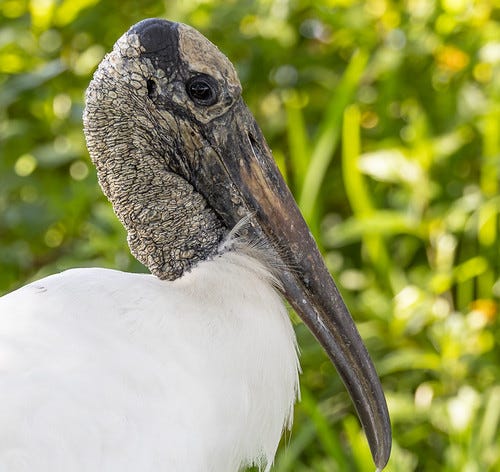
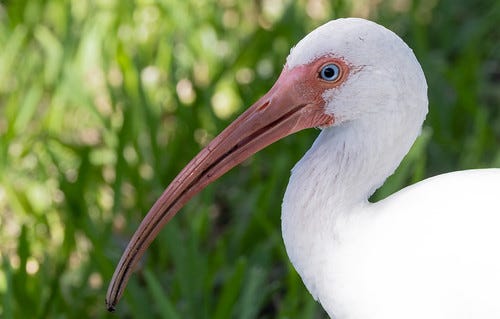
Any visit to Merritt Island is going to be rich in splendid birds. On this visit, we enjoyed two extremely cooperative Wood Storks and a slew of White Ibises at a small park in Titusville…

…a Reddish Egret exactly where I expected to find it along the Black Point Wildlife Drive at Merritt Island National Wildlife Refuge (they’re always at a distance, but oh, well)…

…manatees3 at the refuge’s manatee overlook at the Haulover Canal…

…and wonderfully cooperative Ruddy Turnstones in one of the parking lots along the bridge from Titusville to the island.


In addition to all that and more, that indefatigable non-birding son of mine was the one who found the bird our family is especially fond of, the charismatic, family-oriented, confiding, intelligent, endangered Florida Scrub-Jay. And the pair was exactly where we hoped to find them, on the refuge’s Scrub Ridge Trail.

They checked out the people watching but did not approach us.

People used to be allowed to feed the scrub-jays peanuts—indeed, two decades ago, one of the people working at the entrance to Lake Kissimmee State Park told us that giving the birds peanuts was a great way to see them up close and personal. Back in 2001 when I visited my aunt in the Lake Placid area, she invited me to accompany her and her “lady friends” on their morning walk; she thought I’d enjoy feeding the birds with them. I figured they must be ducks or pigeons, but nope—they were feeding Florida Scrub-Jays, filled with delight without even knowing what they were!

My aunt was living in a brand-new development, and several of her friends were talking about the “big improvements” they were making to their yards, pulling out those “nasty shrubs” and “awful scrub oaks” and putting in “beautiful greenery” and “real trees.” I was there for my Uncle Dick’s memorial service and my aunt was overwhelmed with grief, so I didn’t say anything, but I felt heartsick realizing this destruction of scrub habitat was exactly why these very birds were in so much danger.
Feeding Florida Scrub-Jays is no longer legal except by researchers with permits. A study by Stephen Schoech published in The Condor in 1996 found that Florida Scrub-Jays who received supplemental feeding (dried dog food, peanuts, and mealworms) had higher successful reproduction rates than those who didn’t, but some people argue that feeding them can induce early breeding before high-protein caterpillars and other natural food are available for feeding nestlings. I’ve often cited a study indicating that scrub-jays who take peanuts from people live longer due to their more curious nature, a valuable quality in an opportunistic omnivore, but I can’t find the original source online, and now wonder if the study wasn’t referring to one of the western scrub-jays, not the Florida Scrub-Jay.
Many people cannot be trusted to give them nutritious fare, but many can. Yet even as enforcement of feeding regulations has stepped up, including steep fines, neither the state nor federal government is doing anything to curb rapacious developers and the people buying homes from them from destroying more and more of Florida’s scrub habitat—the most critical and urgent factor in the rapid disappearance of Florida Scrub-Jays. As of 2001—the year I visited my aunt—the Florida Scrub-Jay population had declined over 90 percent in the last century.
Even as it gets harder to find the birds and development continues apace, authorities are still giving the same population estimate, 7,700–9,300, that they were giving in 2001. It’s hard to get accurate current data even as we need it desperately. Places where good habitat remains have become islands surrounded by more and more development, and scrub-jays are one of the few species that virtually never wander away from the habitat they need, so now there is increasing in-breeding as their options shrink. Every moment I spend with Florida Scrub-Jays is precious.

OCTOBER 13: White-eyed Vireo

We started out the day at the Disney Wilderness Preserve, property managed by the Nature Conservancy. My hope was to get good looks and photos of Red-cockaded Woodpeckers—a species I’ve seen before in Florida and Arkansas, but never well enough to get high quality photos. The best I’ve taken, at a distance, were at this preserve.

I thought we’d see or hear at least one or two at a distance—the Nature Conservancy is doing intensive management to help this endangered bird—but no luck.
We did see one of my favorite birds, the Loggerhead Shrike, near the trail’s beginning...

…and a pretty little Northern Parula was very cooperative in front of my camera.


But somehow a persistently singing White-eyed Vireo eclipsed everything.

I’m ever so fond of White-eyed Vireos, ever since I accurately identified one during the Madison, Wisconsin, Christmas Bird Count in 1979—a fact that I’m both proud of and a little defensive about. My partner covering the University of Wisconsin Arboretum was also the count compiler. He said one of his friends had spotted a Yellow-throated Vireo in the Ho-Nee-Um area the week before, so that’s where we headed first. I said I was pretty sure the bird could not have been Yellow-throated—those winter in South America, only a few staying as far north as Cuba and central Mexico. I said that a Blue-headed (then called the Solitary Vireo) or White-eyed Vireo would be much more likely—they both winter in the southern states—and he snorted that White-eyed Vireos don’t make it as far north as Madison even during migration and the breeding season, so of course it couldn’t be that one.
When we first found the bird, we got only partial glimpses but both saw yellow flanks, which the Yellow-throated Vireo does not have. As far as I was concerned, this still left open the possibilities of both Blue-headed and White-eyed, but he wanted to list the bird as Blue-headed and move on—we had a pretty large area to cover. I said even a Blue-headed Vireo is pretty unlikely in Wisconsin in winter and needed better documentation, so I’d catch up to him. But he stuck it out with me and got a full side view before I did. He said it was indeed a Blue-headed Vireo, but “something’s wrong with one eye.” We both got full views a minute later, and yep—the thing “wrong” with its eye was that it was bluish white! It had yellowish spectacles (white in the Blue-headed) and its head was soft gray, not a darker bluish gray. Vindication!!!
He was the count compiler, so he said he’d write it up which was fine by me until I read his report in the CBC results and The Passenger Pigeon, summarized in Sam Robbins’s book, Wisconsin Bird Life. The custom when more than one birder spots and works out a rarity together is for the credit to go to everyone who helped ID it, but he put only his name on the official record for this bird.
So officially, he gets the credit, but oddly enough, if you search for “White-eyed Vireo Wisconsin Christmas bird count 1979,” at least some search engines give all the credit to me, because I mentioned seeing the first one on my species page for the White-eyed Vireo. I wasn’t trying to take full credit—that would have been as unfair as him taking full credit. We both really did see and eventually figure it out, and he’s the one who got us searching for it in the first place.
I’ve amassed a lot of photos of White-eyed Vireos over the year, mostly in Florida, but this is such a cool species and the one we saw at the Disney Wilderness Preserve was so cooperative that I was happy to add more to my photo collection.

October 13 was also the only day of the whole trip when we saw alligators! Those were at the Oakland Nature Preserve, a lovely place that Joe introduced us to.


OCTOBER 14: Anhinga

Most years when we visit Disney World, we see lots of cool birds. This time they were harder to come by. I lugged my camera along for much of the day but took only 27 bird pictures in the park—one Mourning Dove, a few Mallards, and a few of that splendid Florida bird, the Anhinga.

On this trip, I got better pictures of them at Brinson Park, Kissimmee Lakefront Park, and Merritt Island, but oh, well—this really wasn’t a birding day. I got to ride on a couple of the new Star Wars attractions and, as I always do, the “It’s a Small World” ride. 4
Anyway, on this day, there seemed to be an Anhinga somewhere every time we were near water, but none very close. I took most of my pictures (like the one above) while waiting for the ferry to the Magic Kingdom.
The next day, when Russ and I returned to Kissimmee Lakefront Park, I got a video of an Anhinga gular fluttering—the way many birds cool down.
OCTOBER 15: Limpkin

Joe had a lot going on the rest of the week, so Russ and I returned by ourselves to Brinson Park and Kissimmee Lakefront Park. This time, Limpkins were all over the place, including one climbing through the low branches of a tree next to the water.

I’ve seen Limpkin colts here in spring…

…and witnessed lots of interactions between adults during the breeding season, but this being October, they were keeping to themselves.
Limpkins are the only member of their family (Aramidae) but belong to the same order (Gruiformes) as the crane and rail families. They’re in between those families in size, and their plumage is simple brown and white, though they’re hardly dull—the individual feathers are beautifully patterned when seen at close range.

Their vocalizations share qualities with both the guttural trills of cranes and the higher-pitched squeals of gallinules. They weren’t calling on this day, but the only recording I’ve ever made was at this park in April 2019. Limpkins are #4 on my Top Ten list of favorite birds (well, there’s currently a 78-way tie for fourth place). I’m very grateful that even as so many others of my beloved birds are disappearing, Limpkins are thriving.
OCTOBER 16: Pileated Woodpecker
We were given use of our suite for a week, so had to check out this morning, return our car and toll transponder at the airport, and check in to a motel close to the airport for our very early flight tomorrow, so except for saying good-by to the golf course crane family and that extremely vocal mockingbird by the office, we didn’t pay much attention to birds until we’d checked in at the airport hotel. That happened to be a very short walk to Airport Lakes Park. The boardwalk was closed, but birding there was very fun, even giving me a few songbirds I’d missed on the trip—Tufted Titmouse,

Brown-headed Nuthatch, Carolina Wren, and Brown Thrasher.

But my bird of the day was a splendid Pileated Woodpecker—#2 on my Top Ten list (tied with the Blue Jay). That was also one of the last birds we saw as we were leaving the park, putting me in a happy mood that sustained me all the way home.


Before the American Ornithologists’ Union started standardizing English names for American birds, “fox-colored thrush” was one name for the Brown Thrasher.
As splendid as mockingbirds are, they’re also the state bird of four other states—Arkansas, Mississippi, Tennessee, and Texas. I wish Florida would name as their state bird the one bird endemic to the state—that is, found nowhere else on the planet—the Florida Scrub-Jay.
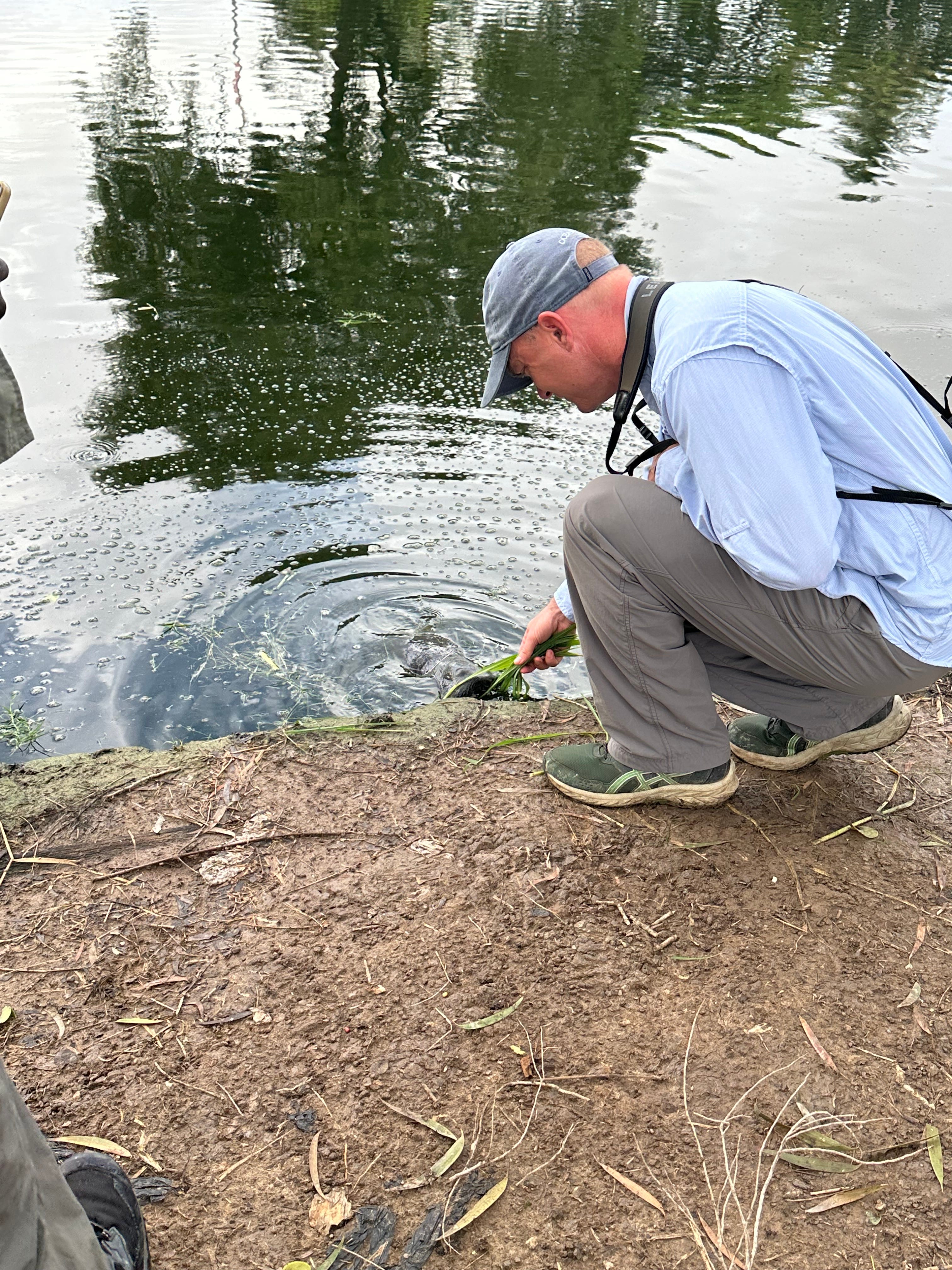
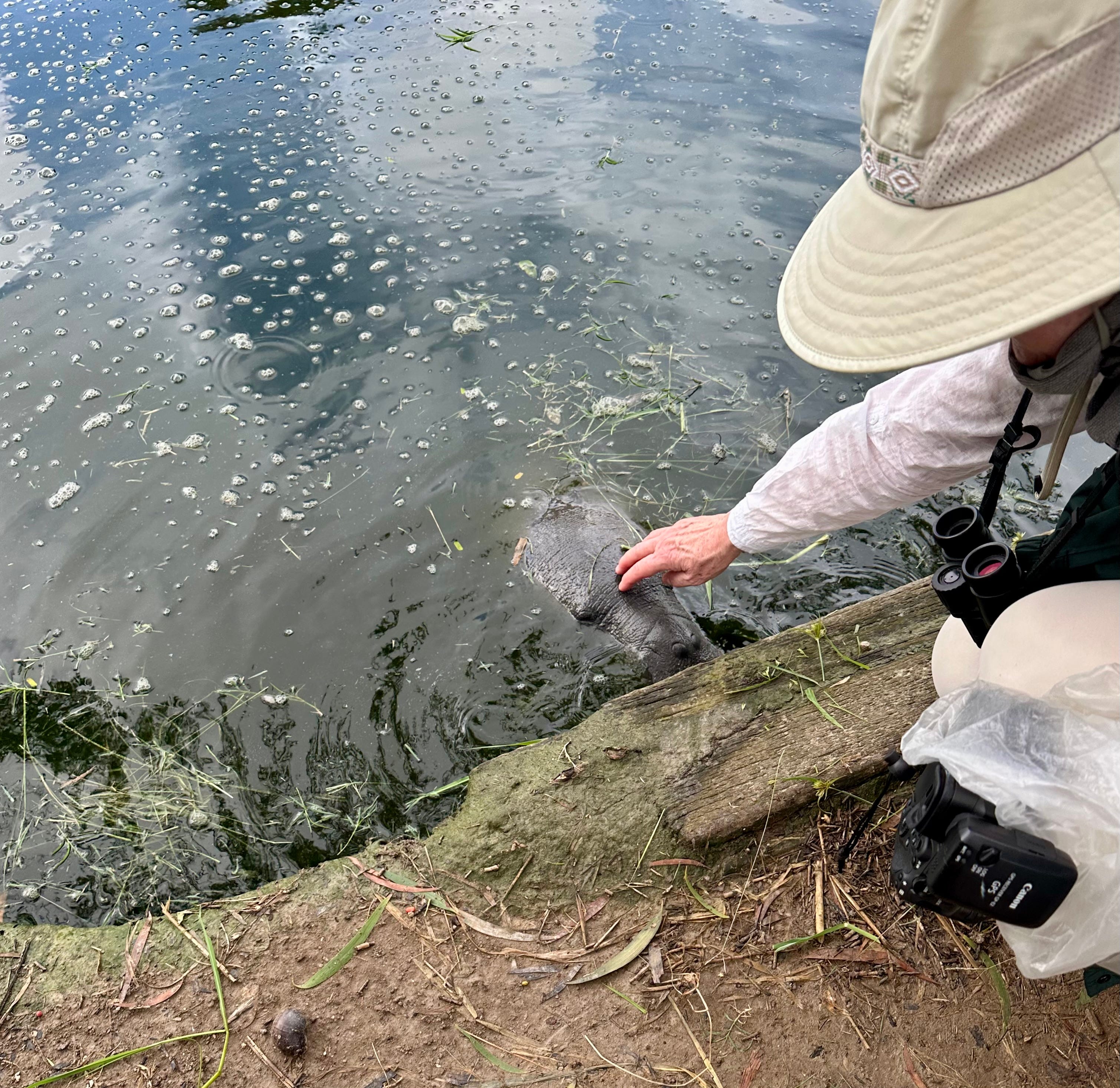
My grandson Walter is a big fan of the PBS show Odd Squad, and one of his favorite characters is Olaf, who is obsessed with potatoes. So I told Walter manatees look like giant underwater potatoes. My photo on this trip (above) shows that. My only photos of their whole bodies were taken at Sea World in 2005. I also have photographic proof that I got to feed one in Guyana last year, a legal and safe [for people and manatees both] tradition in Guyana National Park.


I love the idea that “there’s so much that we share that it’s time we’re aware it’s a small world after all,” an idea that seems especially relevant right now even if Raffi did the definitive job with that concept in his ethereal song, “One Light, One Sun.”