

Whip-poor-will!
Love them or hate them, they make their presence known. At least at night.

(Listen to the radio version here.)

Have you ever watched babies in strollers or backpacks at a shopping mall? Everything is new and draws their gaze—they haven’t figured out what to ignore yet. Without filters, they stare out bewildered, transfixed, their eyes wide with wonder.
Just like one of those babies, when I started birding, my eyes were bewildered and transfixed, scrutinizing every single branch and twig on every single tree. Little by little, I learned that I saw birds more quickly if I focused on movement and sound. That made my birding much more efficient, but it also meant that I missed cool things that really do require scrutinizing every branch.
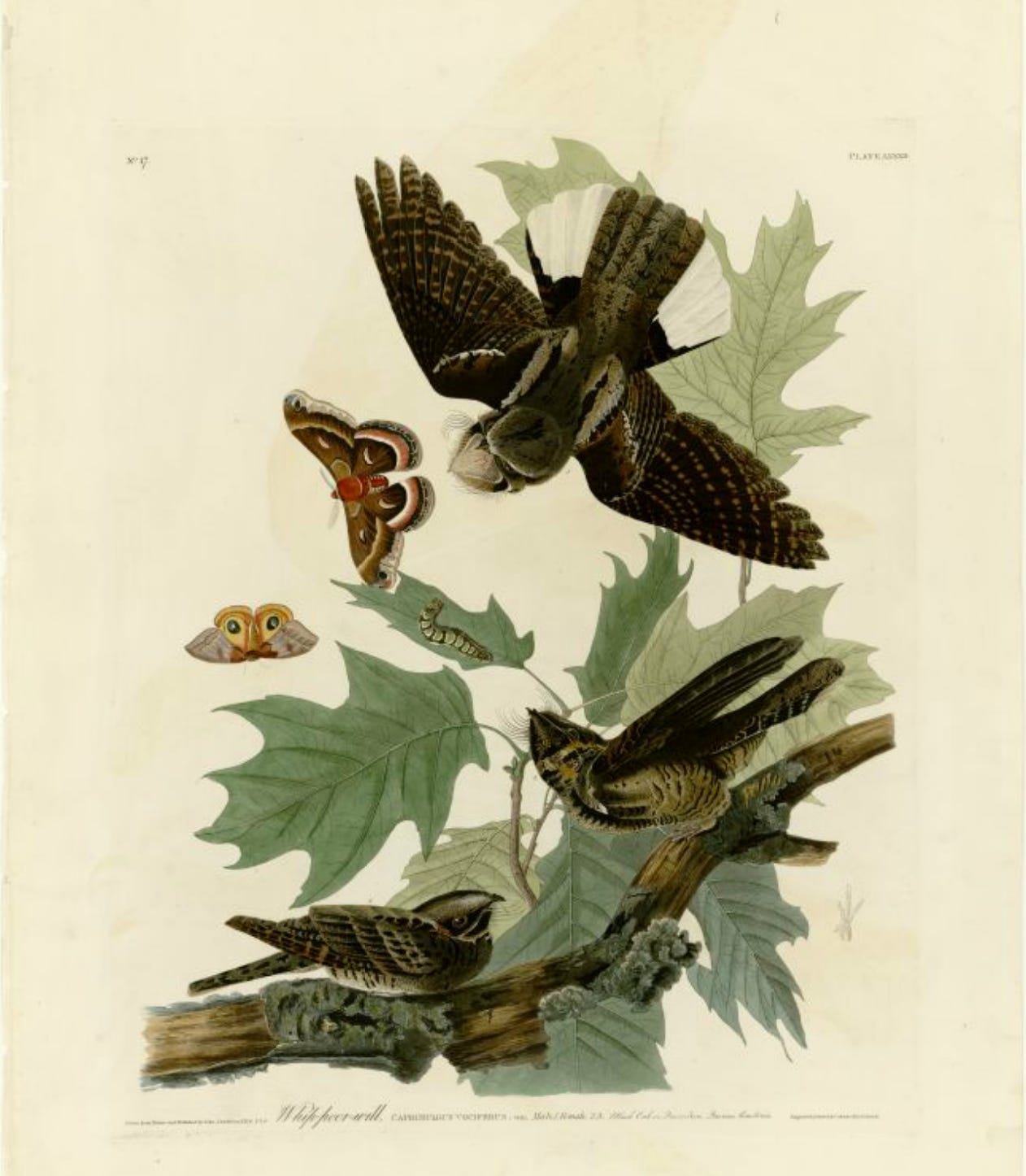
It was during those heady first days before I developed those filters that I spotted my first whip-poor-will during an ornithology class field trip through an East Lansing woodlot. My professor was amazed when I pointed it out—just a bump on a log or, in this case, a thick horizontal branch, its exquisitely camouflaged plumage blending in perfectly with the bark.

I was thrilled—a LIFER!—and my professor said I was the only one he knew who’d seen a whip-poor-will before ever hearing one. Whip-poor-will calls are loud and piercing--almost impossible to not notice if you’re spending evening or pre-dawn morning hours anywhere near one in spring and early summer, but I was a city girl who’d never slept in the woods before I started birding. During daytime, whip-poor-wills are extremely secretive, hardly moving a muscle and keeping their eyes mostly closed.

People love or hate the whip-poor-will’s constant calls, which can go on and on for hours, especially after a long winter when many of us can finally keep our bedroom windows open. In the 1980s and early 90s, I loved hearing them at Camp du Nord up by the Boundary Waters, and my Uncle Elliott used to tell me about the ones he listened to in Galena, Illinois—like me, he enjoyed their persistent calling. But when I talked to humor writer Dave Barry about birds a couple decades ago, he mentioned that a whip-poor-will called all night outside his tent at Camp Sharparoon where he was a camp counselor, and said it made him wish he had a bazooka.
A New England legend says the whip-poor-will can sense a soul departing and capture it as it flees. Another American folk belief that hearing a whip-poor-will singing is an omen of death. One of James Thurber’s darkest short stories, titled “The Whip-poor-will,” is about a whip-poor-will’s persistent calls driving a man to commit a triple murder and suicide. The sexism and, worse, the casual racism in that story are as ugly as the plot.
Me, I love Whip-poor-wills. The vast majority of my encounters have been strictly by ear, but one night in May 1983, back in the days when you had to see a bird to count it on your Minnesota life list, when I was pregnant with my daughter and was bedridden for a few weeks, I heard one in the yard next door. Russ set up a reclining lawn chair in the back yard and helped me into it so I could add it to my state, county, and backyard lists. I’ve also seen a couple flutter here and there at Camp Du Nord. But just hearing them without seeing them has been satisfying, too. I recorded this Eastern Whip-poor-will while teaching a Road Scholar (formerly Elderhostel) class in Wisconsin—we never did see it, but listening to my recording fills me with joy.
The one I spotted fifty years ago remains, to this day, the only roosting whip-poor-will I’ve ever picked out on my own, and up until this very month, on May 7, was the only one I’d ever seen in daytime. But when I was at Magee Marsh in Oak Harbor, Ohio, taking part in an amazing birding festival called The Biggest Week in American Birding, some people located TWO roosting whip-poor-wills along the boardwalk, and I got to not just see but photograph both, one close enough to give me some especially nice photos. I was thrilled!

Eastern Whip-poor-wills eat nothing but flying insects, which they catch on the wing from about a half hour after sunset until it grows too dark to see the insects against the night sky. They start foraging again at first light, quitting for the day about 40 minutes before sunrise. On nights when the moon is bright, they may feed all night.
Whip-poor-wills lay their eggs in phase with the lunar cycle, the chicks hatching on average 10 days before a full moon. As the chicks grow increasingly voracious, the hours of moonlight are increasing, so the parents can maximize the number of insects they catch per night right when the growing chicks need it most. As with many other insectivores, whip-poor-will numbers are declining as moth, butterfly, mayfly, and other flying-insect populations plummet.
Before 2010, America’s two disjunct whip-poor-will populations were believed to belong to a single species, but the southwestern one has a softer call and enough difference in its DNA that it was split off as the Mexican Whip-poor-will. The whip-poor-wills found in Michigan, Minnesota, Wisconsin, and the rest of the eastern states belong to the species now called the Eastern Whip-poor-will. I’ve been lucky enough to have heard the southwestern species in Arizona a few times, and its calls really are softer and less piercing—I doubt it has inspired much by way of folklore or stories about driving people insane. But something about our good old Eastern Whip-poor-will, even when one is keeping me awake nights, will always fill my heart with pleasure and happiness.
The most memorable Whip-poor-will call I heard was at the outdoor American Players Theater in Spring Green WI at dusk during their presentation of a Midsummer’s Night Dream. The stage is surrounded by forest. It certainly added atmosphere to the play.
Whip-poor-wills were the first birds I tried to call (whistle) when I was a little girl in the south. I asked my dad what it was and he pointed one out to me. Thank you.