

Air Quality
Fear and fury along with gratitude for some genuine loveliness.

(Listen to the radio version of Part 1 here and Part 2 here. )
On July 13 and 14, the official Duluth temperature reached 95º and 97º. On those two days, our north-facing, shaded patio reached 97º and 98º, and our south-facing front porch reached an astonishing 101º F. Our heat pump is malfunctioning, but the company has cancelled a couple of appointments already to get it repaired.
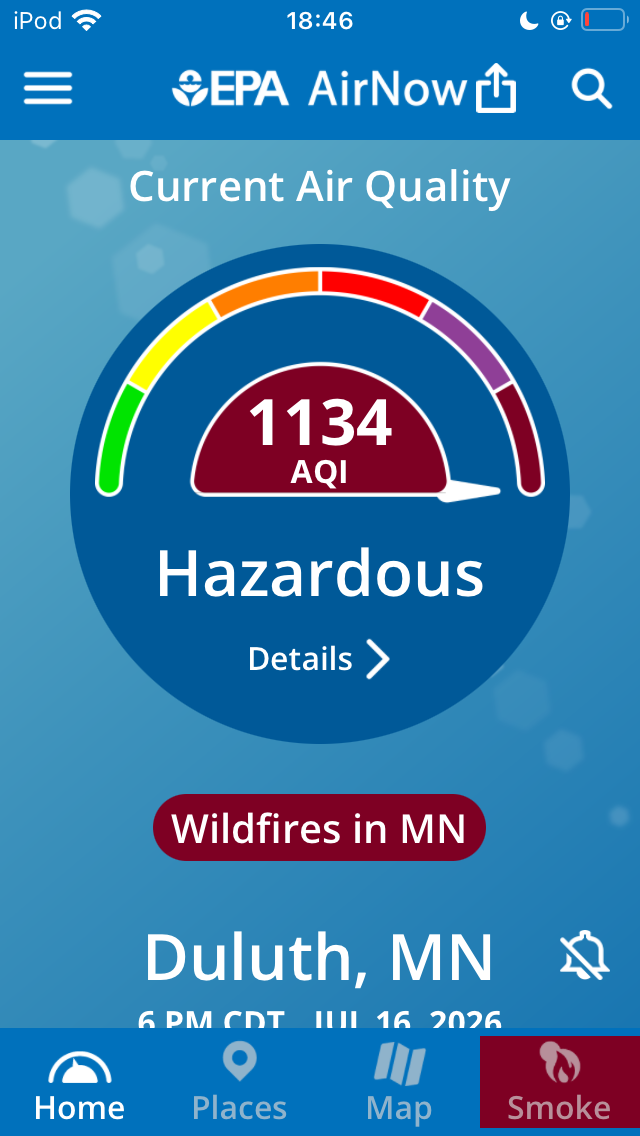
As we’ve learned in recent years, extreme heat goes hand in hand with wildfires, and this week, Duluth’s air quality was the worst I’ve ever experienced. My daughter got a screen grab when the EPA’s website was showing our Air Quality Index (AQI) at a devastating 1134! Their highest level of danger, the maroon “Hazardous” level, only goes from 301–500. We were more than double that!
For three days, from morning till night it stayed so dark that it looked as if a major storm was looming even when, meteorologically, the skies were clear. Russ and I went out to lunch on Thursday at a restaurant on London Road and could not see the lake at all. On those smoke-darkened days, our solar panels produce very little electricity.
We have two air filters in our house, both running at full strength, but even when I’d been indoors for hours my eyes were still burning, I could feel a slight burning sensation when I took a deep breath, and I could detect a faint smell of smoke. On Wednesday during some of the worst of it, my daughter saw her oncologist and I went to the dentist—in both those indoor settings we could still smell smoke. My dental hygienist told me the entire staff had been complaining of headaches. Sensible people outdoors were wearing masks.

I’m growing 6 tomato plants in pots and have to water them several times each day. The whole time I was outside, my eyes and lungs burned.

Just opening the door for the second or two it took me to get in and out, our air filters showed a spike in particulates in the house.
When the risk reaches 201 on the Air Quality Index, the purple level, the EPA website says “The risk of health effects is increased for everyone.” When it reaches the highest, maroon, level, between 301 and 500, the site says, “Health warning of emergency conditions: everyone is more likely to be affected.”
The warning issued on the hazardous days was this:
Everyone needs to cut back on outdoor activities…People with heart or lung disease, older adults, children and teens: Avoid physical activities outdoors. Everyone else: Avoid strenuous outdoor activities or keep physical activities short. Consider moving physical activities indoors or rescheduling them.
Those are sensible guidelines for humans—the ones who have options, at least—but what are animals to do? Before the heat and smoke hit, I’d been watching some delightful baby House Wrens.

Their parents are every bit as attentive and nurturing as the finest human parents, but those poor House Wrens can’t call their babies indoors when the AQI reaches unhealthy or hazardous levels.
At rest, a Northern House Wren’s heart rate was measured as 455 beats per minute, rising to 701 while incubating eggs—for obvious reasons, no one has measured the heart rate when the birds are active. Like all small birds, their respiration rate is also extremely fast. It’s impossible to assess what the heat and horrible air quality are doing to them. I’m still hearing an adult male singing but haven’t heard the tiny chips of the babies all week. I’m hoping they survived the worst of this, but there is no way to know.
I haven’t seen a hummingbird in weeks even though some of my bee balm is in full bloom. My pair of adult catbirds were coming to my just-now ripening juneberries as well as my feeders several times a day, but I haven’t seen them once since Tuesday. Where could they possibly have gone when this disaster is so widespread? Did they share the fate of those canaries in the coal mine whose deaths warned miners that the air was dangerous? There is simply no way to know.
I’m not sure which of my emotions is stronger right now—fear or fury. I’m terrified for my daughter on chemo, my little grandson, and all the other people whose health is already fragile, here in Duluth where we’re over 80 miles from the nearest fires, for all the people even closer, and all the people hundreds of miles away who are also breathing in this hazardous, smoky air. Imagine the damage to wildlife—the nestling birds and mammals too little to escape! Some of the adults and older young near the periphery of the many fires certainly survived, but 77,000 acres of burned area is a lot of valuable habitat for a lot of creatures, not even counting what the smoke is doing, both in the vicinity of the fires and spreading so widely from the actual burn.
As terrified as I am of what all this is doing right now and bodes for the future, I’m also furious. On Wednesday, the Duluth News-Tribune ran a front page headline:
Climate change drives heat wave.
High temperatures throughout Northland more likely to occur due to climate change.
Like DUH! I learned in college, more than half a century ago, that this was coming, but over the 45 years we’ve lived in Duluth, this exact newspaper has always treated climate change as controversial, presenting “both sides” when only one side had actual facts. Scientists at Exxon learned about the certainty of climate change if we kept burning fossil fuels long ago, and even as energy corporations, the Koch brothers, and so many other rich and powerful people suppressed the information as well as they could for decades, they used it to benefit their own bottom line, grooming politicians, oligarchs, and the club of powerful and wealthy insiders to ridicule climate change as a hoax.
Ronald Reagan, the affable and Hollywood-handsome spokesman for General Electric, caught the eyes, and funding, of corporate America, which was enough to elevate him to governor of California and then president of the United States. And as soon as he reached office, he famously tore down the solar panels Jimmy Carter had installed on the White House and turned the thermostat up again, telling the country that there would be no sweaters worn in his White House. And the same forces that elevated Reagan destroyed the political career of Nobel Prize winner Al Gore and more recently, even as things grew increasingly and more obviously dangerous, smeared Greta Thunberg.
Right this very minute, my tax dollars and yours are being used by the Trump administration to pay energy companies billions of dollars in “refunds” to cancel offshore wind turbine projects and abandon their federal leases, and this president still refers to climate change as a hoax, scam, and con job. As the rest of the world grows more and more independent of the fossil fuels that have put so much carbon into our atmosphere and put us all in such dire jeopardy, the United States is moving backward.

I may be filled with fear and fury, but while I was out in my yard a few minutes ago, a female monarch butterfly alighted in my swamp milkweed and allowed me to watch her for at least 3 minutes as she drank from newly opening blossoms. Her delicate tongue, as fine as gossamer, probed each tiny flower individually.

When she flew off, I went upstairs to my office where many of my African violets and Streptocarpus plants are in full bloom.

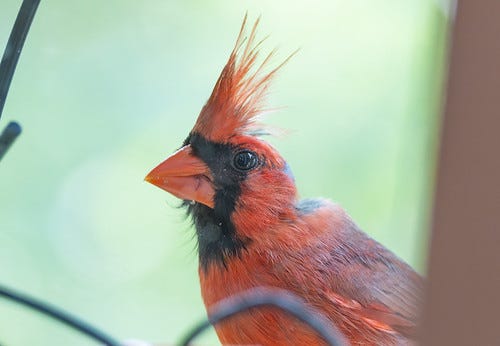
My pair of cardinals, the male recognizable because he’s missing a bunch of feathers on the left side of his nape and head, is still coming to my window feeders.
Chickadees are also visiting the feeder, and baby Hairy and Downy Woodpeckers and Northern Flickers are still chasing their parents everywhere.
There is so much loveliness in this world despite the horrors. Even the ashy dust coating my normally shiny box elder leaves is giving them a soft, silvery sheen. I can’t quite capture this with my camera, but they’re genuinely lovely in an eerie, haunting way.
Ever since that one cluster of bee balm started flowering, I’ve been finding monarch eggs and caterpillars in the nearby milkweed.

Monarchs lay their eggs exclusively on milkweed, but the adults need nectar even when milkweed isn’t blooming, so I suspect the bee balm is what attracted them to my garden in the first place.


Now that the milkweed is also blossoming, I may start seeing even more eggs and caterpillars—at this very moment, at least two eggs are close to hatching.
Not one of my tiny caterpillars has survived to pupate so far, or even to get bigger than about an inch long. I didn’t understand why they were disappearing until I found one of my House Wren parents probing through the milkweed. Toxins in milkweed make monarch caterpillars increasingly toxic as they grow, but these were apparently still too small to be a problem for the birds. I’m hoping my House Wrens will raise at least one more brood this summer, but hoping just as fervently that they’ll look further afield for baby food.
I feel sad but sort of philosophical about those tiny caterpillars—in the natural world, everything is food for something else. But in that natural world, few species eat their own kind, and usually only when their survival is in jeopardy. It’s the billionaires—ostensibly human beings too—who think nothing of harming and outright killing the rest of us and destroying the earth we all need in the name of their quarterly profits.


I just started a “Buy me a coffee” thing for people who want to support my work but don’t want a paid Substack subscription. I am committed to providing all my content for free to anyone who wants to read it, but every bit of support does help me keep working. I have to pay for my website host, my Flickr Pro account, the Adobe software subscriptions that allow me to edit my photos and podcast, the Microsoft Office software that I use for writing and presentations, my recording and photography equipment… It adds up. You can give a one-time tip for as little as $1 if you click on the button. Thank you so much!
Thinking about you all there in the heat and smoke, especially your daughter and others who are vulnerable….. and yes, the birdies.❤️🙏❤️
Holy smoke, Laura! I feel your pain and anger. Here in Rhode Island, 900 miles further away, a dark yellow haze descended upon us. The air smelled strange, but the air quality index was nowhere near as bad as where you are. A single monarch flew nervously around my milkweed patch. Sensing something missing in the general fear-based climate story, I did some digging and recorded my experience, discoveries and reflections. https://wendynadhernyfachon.substack.com/p/smokeany-skies-and-living-soil ...still processing...