

To Sin by Silence
When speaking for the birds becomes controversial

(Listen to the radio version here.)
Twelve score and ten years ago this Fourth of July, a group of immigrants whose parents, grandparents, or they themselves had come to America from England officially adopted the Declaration of Independence. The Declaration said, “all men are created equal” and are endowed by their Creator with the inalienable rights to “life, liberty, and the pursuit of happiness.”
The first time in my life that I heard the word ironic was in seventh grade Catholic school history class, in the context of those very words: our teacher said it was ironic that the man who wrote the Declaration of Independence and many of the men who signed it led lives of luxury thanks to the enforced slavery of human beings who had been endowed by that exact same Creator with those exact same inalienable rights.
Every single day during the eight years I attended Catholic school, and on many of the days I attended public high school, we recited the Pledge of Allegiance, which ends with the lovely words, “with liberty and justice for all. As Pope Leo said on the eve of this milestone Independence Day, “As every American knows, the path to building a society that would embody those high ideals of liberty and justice for all was not always easy and, in many respects, is still a work in progress.”
Our Founding Fathers guaranteed those rights to life, liberty, and the pursuit of happiness and that nebulous concept of liberty and justice for all in the form of the Bill of Rights. The First Amendment was the one I was most keenly aware of. Of course, even as a small child, I knew there was no such thing as free speech in school, church, or at home, not if you didn’t want to get into big trouble. But I figured out when we were preparing for the Sacrament of Penance before our First Communion that there were sins of commission and sins of omission. Stealing from and hurting people were sins of commission—you did something bad. You didn’t have to do anything at all to commit a sin of omission—skipping Mass on a Sunday or Holy Day of Obligation was a mortal sin that would land you in the exact same hell as murderers and thieves, at least if you didn’t get to Confession in time.
The sin I obsessed about—the mortal sin blackening my soul before I even started first grade and the very first sin I confessed when we received our First Penance in second grade—was both a sin of omission and an issue of free speech. I’ve written before about the time my father spewed a horrifyingly hateful racial epithet at a kind stranger in a grocery store. (You can read that story here.) I was mortified as the poor man fled with his little daughter—ashamed of my father, but somehow even more ashamed of myself for not doing anything to stop him or to help them. I don’t remember when I learned the word complicit, but that experience gave me a visceral understanding of its meaning. After my first Confession, I vowed never, ever to stay silent when I could speak out about someone being injured. Ida B. Wells wrote, “The way to right wrongs is to turn the light of truth upon them.”
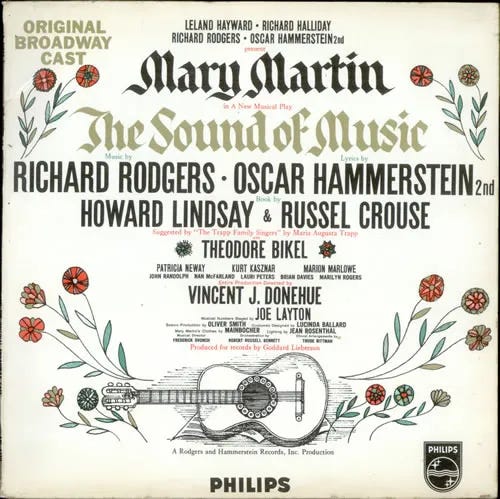
In fifth grade, my class listened repeatedly to the original Broadway soundtrack of The Sound of Music. The song “No Way to Stop It” became my favorite after Mr. Borkowski explained that the Captain, unlike his fiancée Elsa and his friend Max, refused to go along with, or quietly submit to, Nazi occupation of his beloved country. In that original version of the musical, the Captain ends his relationship with Elsa not because he was in love with Maria but specifically because of Elsa’s complicity with evildoers.
Even though it directly affected my family, I didn’t learn about priests abusing children until I was an adult. That was obviously disturbing; what felt even uglier was that the Catholic Church protected those abusive priests and pressured victims and their families to be silent even as those priests continued their abuse in parish after parish.1 So I left the very institution that had taught me that complicity is a sin. Again, the word ironic comes to mind.
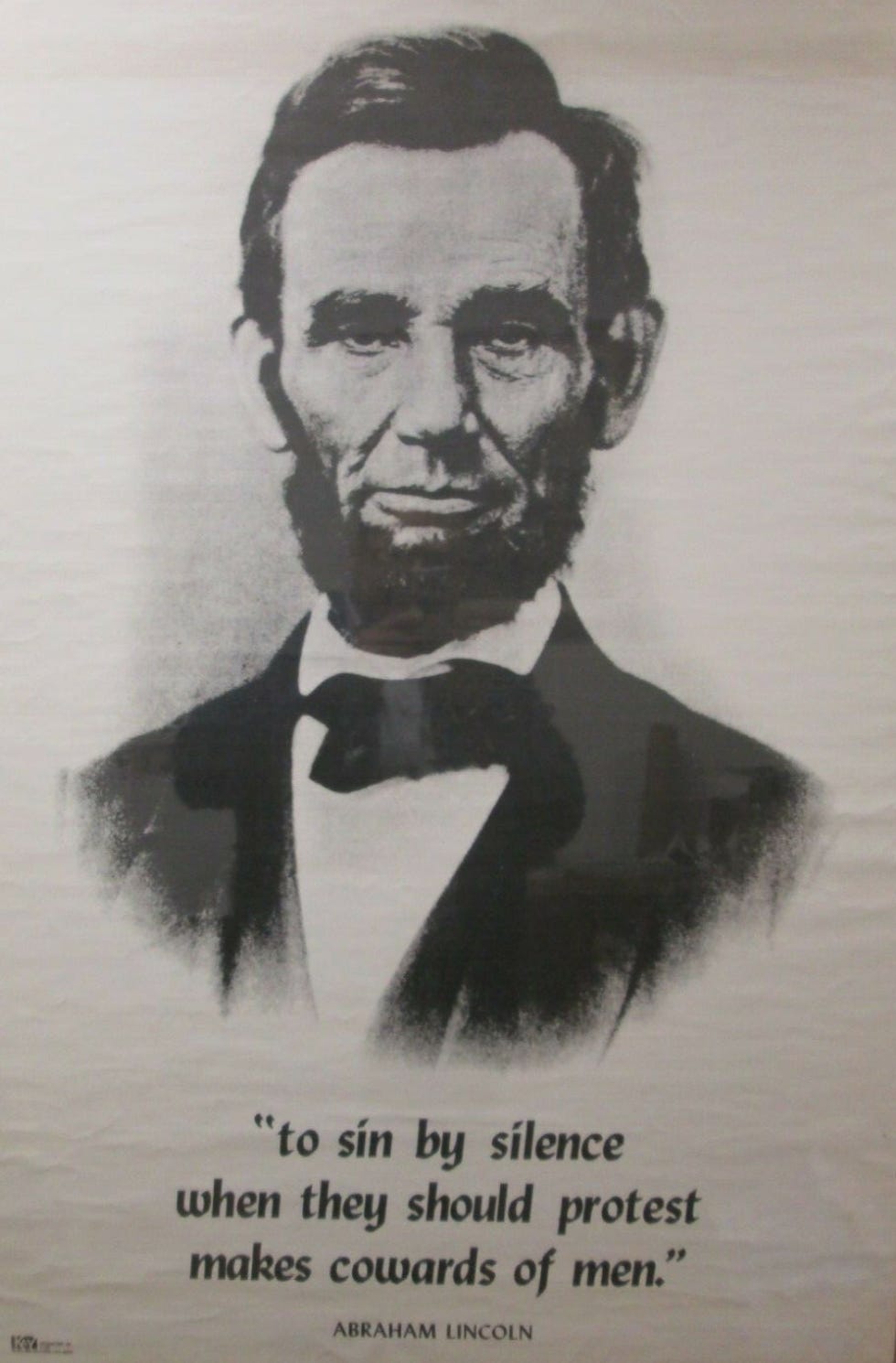
Russ’s college freshman roommate hung up a poster in their room reading, “To sin by silence when they should protest makes cowards of men.” That resonated deeply with me, calling complicit silence not simply cowardice but an outright sin. I’ve spent pretty much my entire adult life speaking out against things that hurt children, birds, and the environment we all need. It’s why I’ve spent the past 40 years producing, as a volunteer, my radio program, and why I’ve deeply appreciated the radio stations that have given me this wonderful forum to speak out.
My own willingness to speak up obviously does not obligate anyone to agree with me—that First Amendment protecting our rights to freedom of speech and religion suggests an even more profound freedom—the freedom to think. Exercising free speech should come with the responsibility of fairness; that’s why when listeners or readers notice an error or disagree with something I’ve said or written, I’ve always taken them seriously and tried to present their arguments fairly. In matters of fact, when I learn that I’m wrong about something, I tell my listeners and readers as quickly as possible. When it’s an issue of opinion or judgment, I try to explain, as fairly as I can, our differing viewpoints even as I may reiterate my own reasoning or point out factual errors in their arguments.
I’m under no obligation other than my own sense of fairness and honesty to air the opinions of people who disagree with me, and the media is under no obligation to air my opinions in the first place. When the only feedback I get from someone is derisive or trollish with no reasoned argument that I can discern, I do my best to ignore it, but it’s irresponsible for community and public radio stations to ignore feedback from their listeners, whether they’re regular listeners, people chancing on a program while driving through town, or powerful individual or corporate donors and sponsors or political figures.
Recently, at least one radio station did not air my program about selling a treasured Duluth park 2 nor segments of my four-part series about hunters and anglers using lead ammo and tackle. These particular programs were quite specifically advocating for birds—bluebirds, owls, and other Duluth species in the first case, and all manner of species, especially but not only eagles, condors, and loons, in the second.
I’m lucky that any stations air any of my radio segments, and I do understand the pressures on public media, both subtle and overt, especially in this political climate. But our right to free speech comes with an obligation to exercise it to protect others, and my agenda is to advocate for birds. I know I don’t have a right to speak out on the radio, but regular listeners should have the right to know when and why I’ve been censored.
One document in Father Kelly’s file on the Bishops Accountability website is a letter he wrote in 1968, after being sent from my parish (St. John Vianney) to St. Catherine of Genoa, to “Your Eminence” (the title reserved for cardinals) saying that he’d wanted to be “a good and holy priest. If this is impossible, then for the salvation of my own soul, I would appeal for laicization.” At this point, he was already abusing boys at that new parish, from which he was soon sent to another parish, and another, and yet others, always after he was found to be abusing children. Despite his written acknowledgment of guilt starting in 1967 and his willingness to leave the priesthood, he was kept on as reports of abuse sent him from one parish to another. Yet the Archdiocese of Chicago claimed that they didn’t hear of any allegations of abuse until 1992, two years after Kelly died. His obituary in the Chicago Sun-Times, dated June 15, 1990, wrote glowingly of how he’d trained altar boys and was “devoted to his pastorly duties.” Had the Church not pressured victims to keep their silence from the start, his first victims would have been his last.
News update: Michael Bernstein’s two petitions both received enough valid signatures that the issue of the Lester River Golf Course will be on the ballot at our next election.
Thank you for this beautiful, thoughtful piece, Laura.
Yes, thank you, Laura for your insightful words.